Not All HR Metrics Are Useful
Most organizations today have access to HR data.
They track metrics.
They run reports.
They build dashboards.
But when it comes to making decisions, many of those metrics are not helpful.
The issue is not a lack of data.
It is a lack of focus and context.
Why Companies Track the Wrong Metrics
It is easy to track HR metrics.
Most systems make it simple to pull reports and build dashboards.
But many organizations track metrics because they can, not because they should.
Common reasons include:
- relying on default system reports
- tracking what others track
- focusing on volume instead of value
- lacking clear definitions of success
According to research from Gartner, organizations often struggle to connect HR data to business outcomes when metrics are not aligned with decision-making needs.
Source
Gartner HR Technology Research - https://www.gartner.com/en/human-resources
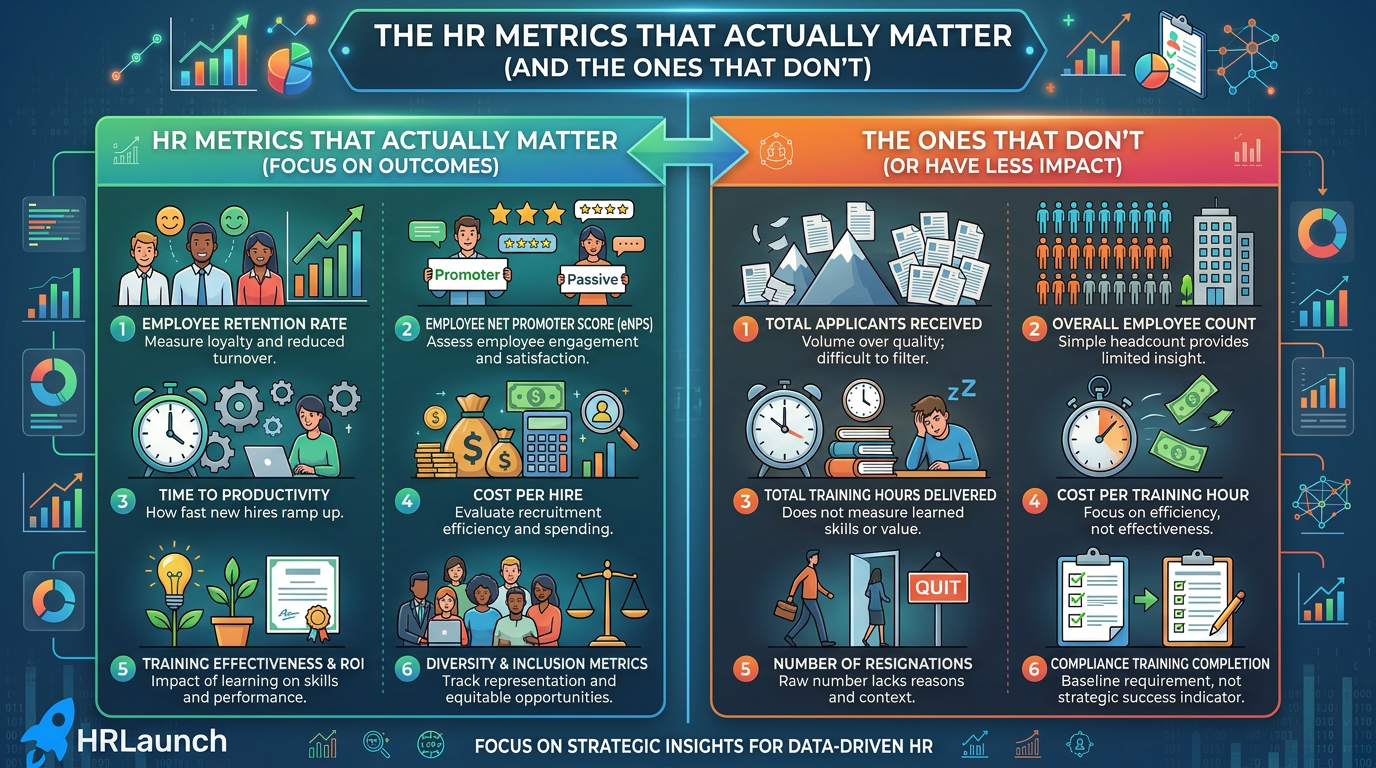
The HR Metrics That Actually Matter
The most valuable HR metrics are the ones that support decisions.
They are clear, consistent, and tied to outcomes.
Time to Fill
Time to fill measures how long it takes to move from opening a role to accepting an offer.
Why it matters:
- highlights inefficiencies in hiring
- identifies delays in decision-making
- impacts team productivity
Offer Acceptance Rate
This metric tracks how often candidates accept offers.
Why it matters:
- reflects competitiveness in the market
- highlights compensation or expectation gaps
- indicates candidate experience quality
Turnover Rate (With Context)
Turnover becomes useful when broken down into:
- voluntary vs involuntary turnover
- department or role-specific turnover
- early tenure turnover
Why it matters:
- identifies retention challenges
- highlights management or culture issues
- supports workforce planning
Cost Per Hire
This measures the total cost associated with hiring a new employee.
Why it matters:
- provides insight into recruiting efficiency
- helps manage hiring budgets
- supports resource allocation
Employee Retention by Role or Team
Focusing on specific groups provides more actionable insight than overall retention.
Why it matters:
- identifies problem areas
- supports targeted improvements
- helps prioritize retention efforts
Employee Net Promoter Score (eNPS)
eNPS measures how likely employees are to recommend your company as a place to work.
Why it matters:
- provides insight into employee sentiment
- highlights potential retention risks
- helps identify cultural or leadership issues
When used consistently, it can reveal trends over time.
Time to Productivity
This metric tracks how long it takes for a new hire to become fully productive.
Why it matters:
- reflects onboarding effectiveness
- impacts team performance and output
- highlights gaps in training or role clarity
Training Effectiveness and ROI
This goes beyond completion rates to measure impact.
Why it matters:
- evaluates whether training improves performance
- ensures resources are being used effectively
- connects learning to business outcomes
Diversity and Inclusion Metrics (With Context)
Diversity metrics often include representation across different groups.
Why they matter:
- provide visibility into hiring and workforce composition
- support broader organizational goals
However, it is important to recognize:
Diversity and inclusion are not just metrics to meet.
They are about building strong teams with a range of perspectives while still ensuring the right people are hired for the role.
Focusing only on the numbers without considering fit and capability can create unintended challenges.
The Metrics That Often Don’t Add Value
Not all metrics provide meaningful insight.
Some create more confusion than clarity.
Overall Employee Count
Simple headcount provides limited insight on its own.
Without context, it does not explain:
- growth trends
- productivity
- workforce composition
Total Number of Applicants
A high number of applicants does not indicate:
- candidate quality
- hiring success
It can be misleading without additional context.
Number of Resignations
Tracking the number of resignations alone lacks meaning.
Without understanding:
- why employees are leaving
- where they are leaving from
this metric does not support decision-making.
Total Training Hours Delivered
More training hours does not mean better outcomes.
This metric does not measure:
- effectiveness
- retention of information
- impact on performance
Cost Per Training Hour
This metric focuses on cost rather than value.
It does not answer:
- whether training is effective
- whether it improves performance
Generic Engagement Scores Without Context
Broad engagement scores can be difficult to act on when:
- they lack specificity
- they are not tied to actions
- no follow-up occurs
According to PwC, organizations often struggle to translate engagement data into meaningful action.
Source
PwC Workforce of the Future - https://www.pwc.com/us/en/services/consulting/workforce-of-the-future.html
Too Many Metrics at Once
Tracking too many metrics creates noise.
This leads to:
- lack of focus
- slower decision-making
- difficulty identifying priorities
More data does not equal better insight.
What Useful HR Metrics Have in Common
The most effective metrics share a few key characteristics.
They are:
- clearly defined
- consistently tracked
- tied to business outcomes
- easy to understand and act on
If a metric does not support a decision, it may not be necessary.
If This Is Happening in Your Business, Your Metrics Are Not Working
These are common indicators that HR metrics are not providing value:
- reports are reviewed but not used for decisions
- metrics vary depending on who runs the report
- leadership does not trust the data
- too many metrics are being tracked without clear purpose
- data requires manual cleanup before use
If several of these are true, the issue is not the data.
It is how it is being used.
How to Focus on the Right Metrics
Improving HR metrics does not require more data.
It requires alignment.
Define What You Need to Know
Start with key questions:
- where are we losing candidates
- why are employees leaving
- how effective is our onboarding
- are training programs improving performance
Align Metrics With Decisions
Each metric should support a specific decision or action.
Standardize Definitions
Ensure consistency in:
- how metrics are calculated
- which data sources are used
- how results are interpreted
Limit the Number of Metrics
Focus on a small set of metrics that provide the most value.
Use Systems to Support Accuracy
HR systems should be configured to:
- capture consistent data
- support reporting needs
- reduce manual work
How HRLaunch Technology Helps
How HRLaunch Technology Helps
At HRLaunch Technology, we help organizations move from tracking data to using data for decision-making.
Many companies have access to HR metrics, but struggle to determine which ones actually matter and how to use them effectively.
Our approach focuses on:
- defining meaningful HR metrics tied to business outcomes
- standardizing how data is captured and reported
- aligning reporting with leadership decision-making needs
- improving data structure and consistency
We work with small, mid-sized, and growing businesses to ensure HR data is not just available, but actionable.
The goal is to turn HR reporting into a tool for better decisions, not just a collection of numbers.
Final Thoughts
HR metrics should provide clarity.
Not complexity.
Tracking the right metrics helps organizations make better decisions about hiring, retention, and workforce management.
Tracking the wrong ones creates noise.
The goal is not to measure everything.
It is to measure what matters.