Having an HR Strategy Is Not the Same as Executing It
Many organizations have a clear vision for HR.
They want:
- better employee experiences
- stronger hiring processes
- improved retention
- scalable systems and workflows
On paper, the strategy makes sense.
But in practice, execution often looks very different.
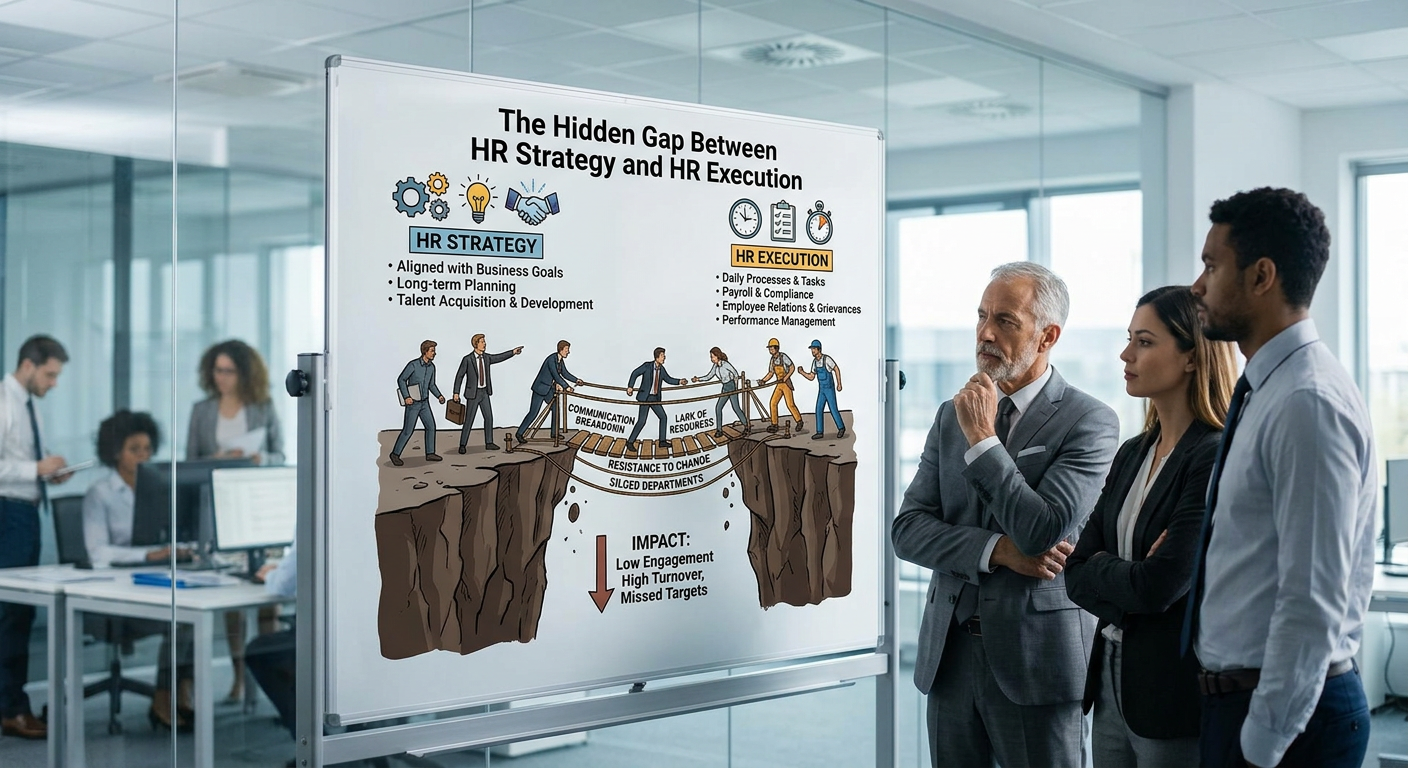
That gap is where many HR problems begin.
What HR Strategy Usually Focuses On
HR strategy typically focuses on long-term goals such as:
- workforce growth
- employee engagement
- leadership development
- operational scalability
- compliance improvement
These goals are important.
But strategy alone does not create operational consistency.
What HR Execution Actually Looks Like
Execution is what happens day to day.
It includes:
- how onboarding is handled
- how managers follow processes
- how approvals move through workflows
- how employee data is maintained
- how systems are actually used
This is where strategy either becomes operational reality—or breaks down.
Where the Gap Usually Appears
The disconnect between strategy and execution often happens quietly.
Processes Are Not Clearly Defined
Leadership may want:
- consistent onboarding
- structured hiring
- standardized employee experiences
But if workflows are not clearly documented:
- managers create their own approaches
- execution varies across teams
- outcomes become inconsistent
Systems Do Not Match Operational Reality
Organizations often implement systems to support strategy.
But if the system is not aligned with actual workflows:
- manual work continues
- employees bypass processes
- reporting becomes unreliable
The strategy exists.
The operational structure does not.
Ownership Is Unclear
One of the biggest execution problems is unclear ownership.
Questions like these often emerge:
- who owns onboarding
- who maintains compliance tracking
- who manages workflow consistency
Without ownership, execution becomes fragmented.
Managers Operate Differently
A company may have one intended process.
But in practice:
- each manager handles situations differently
- approvals vary by department
- employee experiences become inconsistent
The strategy loses consistency during execution.
Reporting Does Not Support Decision-Making
Leadership may want workforce visibility.
But if data is:
- inconsistent
- manually maintained
- fragmented across systems
then reporting becomes difficult to trust.
According to research from Gartner, organizations struggle to achieve workforce visibility when HR processes and data are not operationally aligned.
Source
Gartner HR Technology Research - https://www.gartner.com/en/human-resources
Why This Gap Gets Worse as Companies Grow
At smaller company sizes, execution gaps are easier to manage.
People communicate directly.
Processes remain informal.
But growth changes complexity.
As organizations scale:
- more managers execute processes
- more systems become involved
- more employees require consistency
Without operational structure, strategy becomes increasingly difficult to maintain.
The Hidden Cost of the Gap
The impact is often larger than companies realize.
This gap creates:
- inconsistent employee experiences
- operational inefficiency
- manual administrative work
- unreliable reporting
- compliance risk
Over time, leadership begins to feel friction everywhere.
But the root cause is often execution.
If This Is Happening in Your Business, the Gap May Already Exist
These are common indicators of misalignment between HR strategy and execution:
- managers handle the same process differently
- workflows rely heavily on manual follow-up
- systems are underutilized
- onboarding varies across departments
- reports require manual cleanup
- employees receive inconsistent experiences
If several of these are true, the issue is likely not the strategy itself.
It is operational execution.
How to Close the Gap Between Strategy and Execution
The solution is not more strategy meetings.
It is operational alignment.
Standardize Core Workflows
Ensure processes are:
- documented
- repeatable
- consistently followed
Align Systems With Processes
Technology should support how HR actually operates day to day.
Define Ownership Clearly
Clarify responsibility for:
- workflows
- approvals
- compliance tracking
- system management
Improve Data Structure
Reliable execution depends on reliable data.
Focus on Operational Consistency
Execution should not vary significantly by manager or department.
According to research from Deloitte, organizations that operationalize workforce strategy through aligned systems and processes achieve stronger long-term outcomes.
Source
Deloitte Human Capital Trends - https://www2.deloitte.com/us/en/insights/focus/human-capital-trends.html
How HRLaunch Technology Helps
At HRLaunch Technology, we help organizations close the gap between HR strategy and operational execution.
Many businesses know what they want HR to achieve, but struggle to create the structure needed to execute consistently.
Our approach focuses on:
- evaluating current HR workflows and operational gaps
- identifying inconsistencies between strategy and execution
- designing scalable, repeatable HR processes
- aligning systems, workflows, and ownership structures
We work with small, mid-sized, and growing businesses to ensure HR strategy is not just defined, but operationally supported.
The goal is not simply to create HR plans.
It is to build HR operations that consistently deliver them.
Final Thoughts
HR strategy matters.
But execution determines whether that strategy actually works.
The gap between the two is where inefficiency, inconsistency, and frustration often emerge.
The organizations that scale effectively are the ones that align:
- strategy
- processes
- systems
- operational ownership
Because strong HR is not just about vision.
It is about execution that consistently supports it.