The Shortcut That Becomes the System
Most HR workarounds don’t start as problems.
They start as solutions.
A quick fix.
A temporary adjustment.
A way to move faster.
“We’ll just track this in a spreadsheet for now.”
“Let’s handle this outside the system.”
In the moment, it feels efficient.
Over time, it becomes something else entirely.
What HR Workarounds Actually Look Like
Workarounds often blend into daily operations, making them easy to overlook.
Common examples include:
- tracking employee data in spreadsheets instead of the HR system
- managing onboarding tasks through email instead of workflows
- manually reminding managers about approvals or deadlines
- storing documents across shared drives and inboxes
- duplicating data across multiple systems
Individually, these may seem minor.
Collectively, they create complexity.
Why Workarounds Start
Workarounds are rarely intentional.
They usually begin because:
- the system isn’t fully configured
- processes are unclear
- timelines are tight
- teams are trying to solve immediate problems
Instead of fixing the root issue, organizations create a temporary path around it.
That temporary path often becomes permanent.
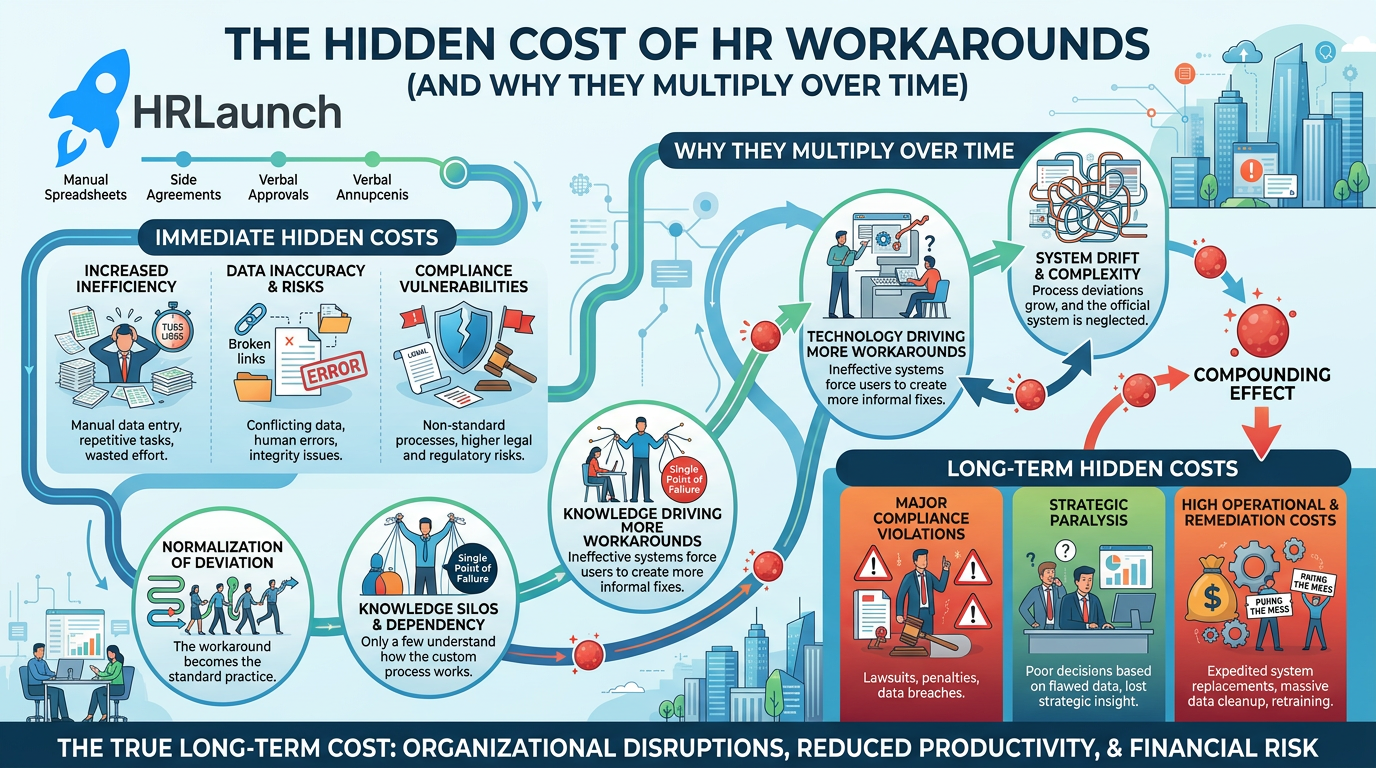
Why Workarounds Multiply Over Time
Workarounds don’t stay contained.
They spread.
One Workaround Leads to Another
When one process is handled outside the system, it often impacts others.
For example:
- tracking onboarding manually leads to manual compliance tracking
- manual data updates lead to inconsistent reporting
Each workaround creates a need for another.
Teams Build Their Own Processes
Different teams may create their own ways of handling HR tasks.
This leads to:
- inconsistent workflows
- duplicated effort
- lack of standardization
Systems Become Less Trusted
As workarounds increase, confidence in the system decreases.
People begin to rely more on:
- spreadsheets
- manual tracking
Instead of the system itself.
The Hidden Costs of HR Workarounds
The impact of workarounds is often underestimated.
Increased Administrative Time
Manual processes require more effort.
Teams spend time:
- updating multiple systems
- chasing information
- reconciling data
Data Inconsistency
When information exists in multiple places:
- data becomes inconsistent
- reports don’t align
- decision-making is impacted
Reduced Visibility
Workarounds limit the ability to see what is happening across the organization.
This affects:
- reporting
- workforce planning
- compliance tracking
Compliance Risk
When processes are not centralized:
- deadlines can be missed
- documentation may be incomplete
- audit trails are harder to maintain
According to research from PwC, organizations often struggle to realize the full value of HR technology when processes are not aligned with systems.
Source
PwC Workforce of the Future - https://www.pwc.com/us/en/services/consulting/workforce-of-the-future.html
Rework and System Fatigue
Over time, organizations may need to:
- clean up data
- reconfigure systems
- retrain teams
This creates additional cost and disruption.
If This Is Happening in Your Business, Workarounds Are Driving Your HR Operations
These are common indicators that workarounds have become embedded in your processes:
- key information is tracked outside the HR system
- multiple versions of the same data exist
- teams rely on spreadsheets to manage HR tasks
- processes vary by department or manager
- reports require manual cleanup before use
- system features are not being fully utilized
If several of these are true, workarounds are no longer temporary.
They are part of your operating model.
The Root Issue: Misalignment Between Systems and Processes
Workarounds are not the problem themselves.
They are a symptom.
The underlying issue is misalignment between:
- how the business operates
- how systems are configured
- how data is structured
When systems do not support processes, people create alternatives.
How to Eliminate Workarounds
Fixing workarounds is not about removing them all at once.
It is about addressing the root causes.
Identify Where Workarounds Exist
Start by understanding:
- which processes are happening outside the system
- where manual work is occurring
- how data is being managed
Align Systems With Processes
Ensure that systems are configured to support how your organization actually operates.
Centralize Data
Establish a single source of truth for employee information.
Standardize Workflows
Create consistent processes across teams and departments.
Assign Ownership
Define who is responsible for:
- system management
- data integrity
- ongoing optimization
How HRLaunch Technology Helps
At HRLaunch Technology, we help organizations identify and eliminate HR workarounds by building structured, consistent processes.
Workarounds often develop when systems and workflows are not aligned with how the business actually operates.
Our approach focuses on:
- identifying where manual work and workarounds exist
- standardizing workflows across teams
- aligning systems with real operational needs
- reducing duplication and inefficiency
We work with small, mid-sized, and growing businesses to replace temporary fixes with scalable solutions.
The goal is to create HR operations that function consistently without relying on manual intervention.
Final Thoughts
HR workarounds don’t feel like problems when they start.
They feel like solutions.
But over time, they create complexity, inefficiency, and risk.
The goal is not just to eliminate workarounds.
It is to build systems and processes that make them unnecessary.
Because when systems are aligned with how your business operates, workarounds are no longer needed.