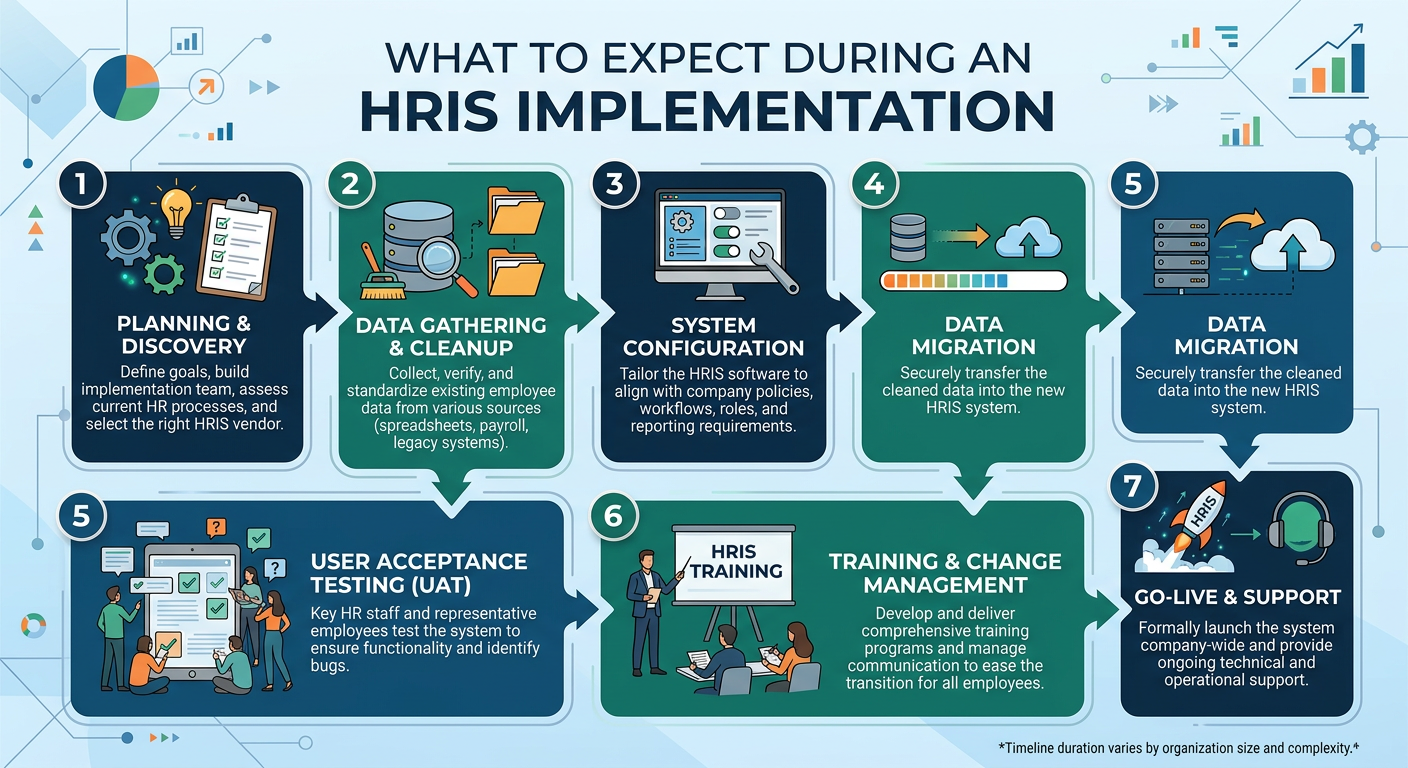
Why Most HRIS Implementations Struggle
HRIS implementations are often expected to be straightforward.
Select a system.
Configure it.
Go live.
But in reality, many implementations face delays, rework, and frustration.
The issue is not usually the system.
It is the lack of preparation before implementation begins.
What This Checklist Is Designed to Do
This checklist is designed to help small and mid-size businesses:
- prepare before implementation starts
- avoid common mistakes
- align processes, data, and systems
- reduce delays and rework
A successful implementation starts well before configuration.
Phase 1: Pre-Implementation Readiness
This is the most critical phase.
Skipping or rushing this step often leads to issues later.
Define Your HR Processes
Before selecting or configuring a system, ensure you understand how HR operates today.
Document:
- hiring workflows
- onboarding processes
- employee lifecycle changes
- approval structures
Clarity here prevents confusion during setup.
Identify Gaps and Inefficiencies
Evaluate where your current processes are:
- inconsistent
- manual
- unclear
This helps ensure the new system improves operations instead of replicating problems.
Establish Ownership
Define who is responsible for:
- implementation decisions
- system configuration
- data management
- ongoing system ownership
Clear ownership reduces delays.
Align Stakeholders
Ensure key stakeholders are aligned on:
- goals of the implementation
- expected outcomes
- timelines and responsibilities
Misalignment early leads to rework later.
Phase 2: Data Preparation
Data is one of the most overlooked areas of implementation.
Audit Your Data
Review current data for:
- accuracy
- completeness
- consistency
This includes employee records, job titles, and organizational structure.
Standardize Data
Ensure consistency in:
- naming conventions
- job titles
- department structures
This improves reporting and system usability.
Clean Up Data
Remove:
- duplicate records
- outdated information
- incomplete entries
According to research from Gartner, poor data quality is a major barrier to successful HR technology outcomes.
Source
Gartner HR Technology Research - https://www.gartner.com/en/human-resources
Phase 3: System Selection and Planning
Choosing the right system is important, but it should be based on your needs.
Define System Requirements
Identify what your system must support:
- core HR functions
- reporting needs
- integrations
- compliance requirements
Evaluate System Fit
Ensure the system aligns with:
- your processes
- your growth plans
- your operational complexity
Plan Implementation Scope
Define what is included in the initial implementation.
Avoid trying to do everything at once.
Phase 4: Configuration and Setup
This is where preparation is put into action.
Configure Workflows
Align system workflows with your defined processes.
Set Up Data Structure
Ensure the system reflects:
- organizational hierarchy
- job structures
- reporting relationships
Test Before Going Live
Conduct testing to ensure:
- workflows function correctly
- data is accurate
- reporting works as expected
Phase 5: Training and Adoption
A system is only effective if it is used correctly.
Train Users
Provide training for:
- HR teams
- managers
- employees
Ensure they understand how to use the system.
Communicate Changes
Set clear expectations for:
- new processes
- system usage
- responsibilities
Monitor Adoption
Track:
- system usage
- process adherence
- areas of confusion
Phase 6: Post-Implementation Optimization
Implementation does not end at go-live.
Review System Performance
Evaluate:
- workflow effectiveness
- reporting accuracy
- user experience
Address Gaps
Identify areas where:
- processes need adjustment
- configuration needs improvement
- additional features can be used
Continuously Improve
As your business evolves, your system should as well.
According to research from Deloitte, organizations that continuously optimize their HR systems achieve better long-term outcomes.
Source
Deloitte Human Capital Trends - https://www2.deloitte.com/us/en/insights/focus/human-capital-trends.html
If This Is Happening in Your Implementation, You May Be Missing Key Steps
These are common indicators that preparation was not sufficient:
- workflows are being defined during configuration
- data requires ongoing cleanup
- timelines continue to shift
- users are unsure how to use the system
- processes vary after go-live
If several of these are present, gaps likely exist in earlier phases.
How HRLaunch Technology Helps
At HRLaunch Technology, we help organizations approach HRIS implementation with the structure and preparation needed for long-term success.
Many implementation challenges are not caused by the system, but by gaps in processes, data, and alignment.
Our approach focuses on:
- assessing current HR operations before implementation
- defining workflows and system requirements upfront
- preparing and structuring data for migration
- guiding system selection based on operational needs
- supporting implementation and post-go-live optimization
We work with small, mid-sized, and growing businesses to ensure implementations are aligned with how their business actually operates.
The goal is not just to implement a system.
It is to build a foundation that supports efficient, scalable HR operations.
Final Thoughts
HRIS implementations are not just technical projects.
They are operational changes.
The difference between a smooth implementation and a difficult one often comes down to preparation.
When processes, data, and ownership are clearly defined before implementation begins, systems are more likely to succeed.
The goal is not just to go live.
It is to go live with a system that works.