Compliance Gets More Complex as You Grow
In the early stages of a business, HR compliance often feels simple.
You hire employees.
You run payroll.
You manage day-to-day operations.
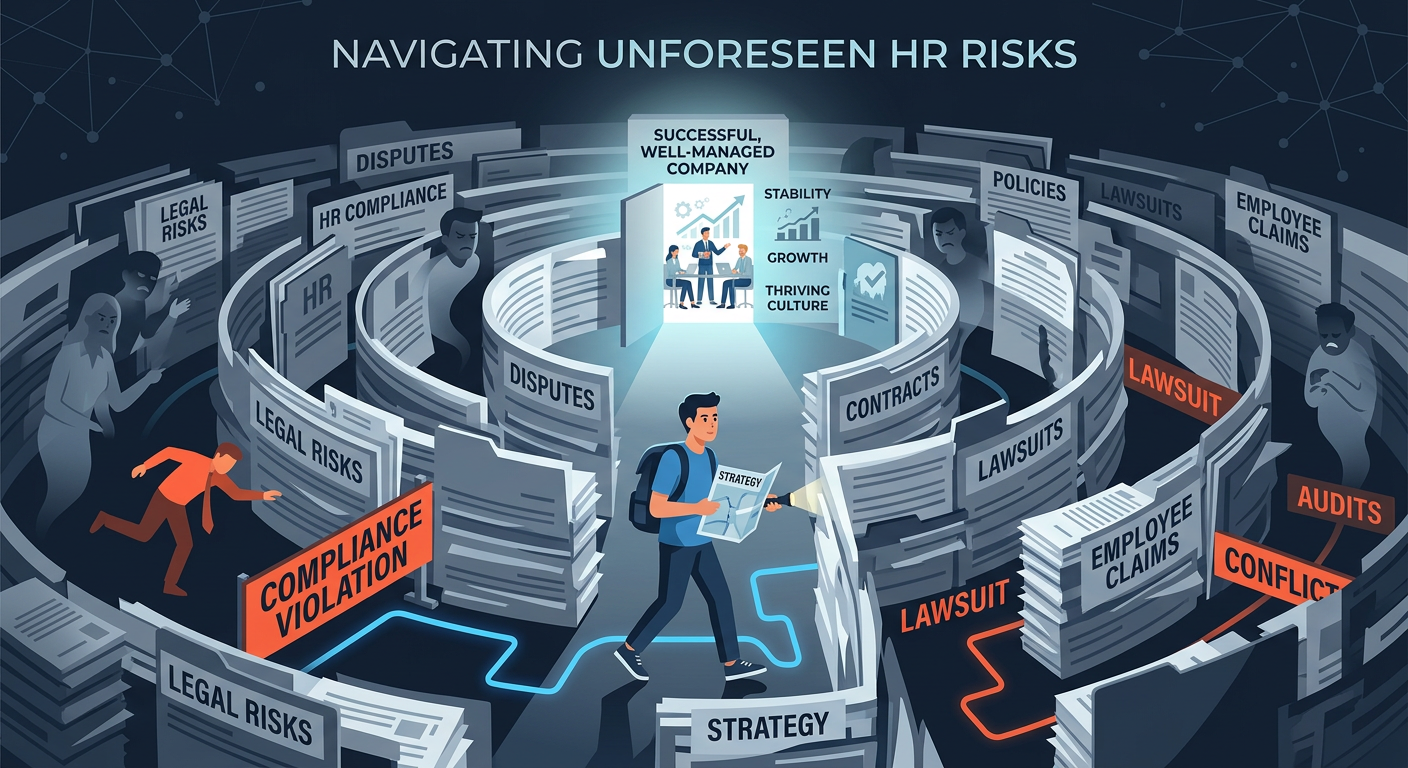
But as your team grows, compliance requirements expand quickly—and often without much visibility.
What worked at 5 employees does not work at 25.
What worked at 25 does not work at 75.
And many startups and small businesses don’t realize they’ve crossed key compliance thresholds until issues arise.
Why Compliance Is Often Overlooked
Startups and growing companies are typically focused on:
- revenue growth
- hiring
- operations
- customer acquisition
Compliance tends to be reactive rather than proactive.
This creates risk because many HR compliance requirements are:
- threshold-based
- time-sensitive
- dependent on proper documentation
According to guidance from the U.S. Department of Labor, employers are responsible for understanding and complying with federal labor laws as their workforce grows.
Common HR Compliance Risks for Small Businesses
There are several areas where startups and growing companies most commonly run into compliance issues.
Missing Required Labor Law Posters
One of the most basic—but frequently missed—requirements is displaying required labor law posters.
Employers are required to post federal and state notices that inform employees of their rights.
These may include:
- minimum wage laws
- workplace safety requirements
- anti-discrimination protections
- employee rights under federal laws
Failing to display required posters can result in penalties, even if unintentional.
Source
U.S. Department of Labor Poster Requirements - https://www.dol.gov/general/topics/posters
Misunderstanding FMLA Requirements
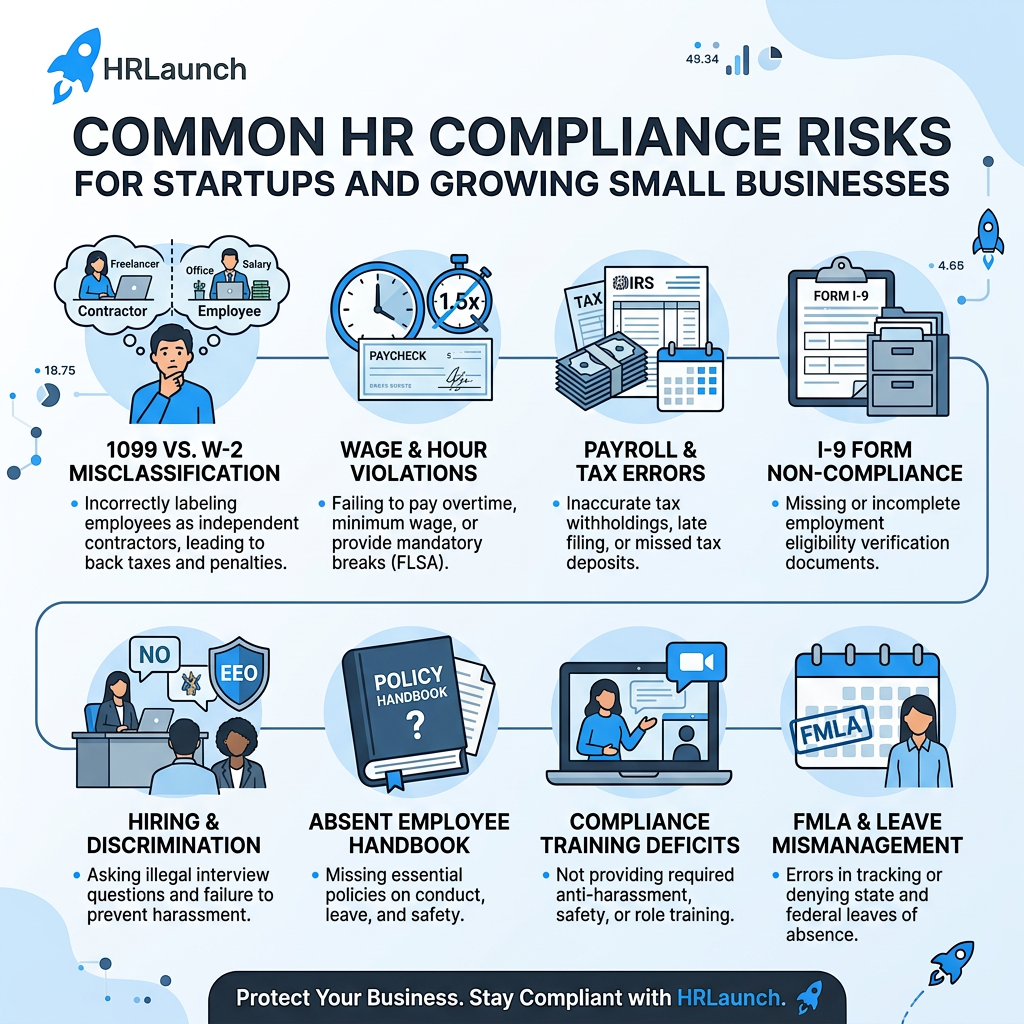
The Family and Medical Leave Act (FMLA) provides eligible employees with unpaid, job-protected leave for specific family and medical reasons.
Key considerations include:
- Applies to employers with 50 or more employees
- Requires proper tracking of employee eligibility
- Requires documentation and job protection compliance
Common mistakes include:
- not tracking eligibility correctly
- failing to provide required notices
- mismanaging leave timelines
Source
U.S. Department of Labor FMLA Overview - https://www.dol.gov/agencies/whd/fmla
ADA Compliance Gaps
The Americans with Disabilities Act (ADA) requires employers to provide reasonable accommodations for qualified employees with disabilities.
As companies grow, they must ensure:
- accommodation requests are handled consistently
- documentation is maintained
- decisions are compliant with federal guidelines
Common issues include:
- inconsistent handling of accommodation requests
- lack of documentation
- unclear internal processes
Source
U.S. Equal Employment Opportunity Commission ADA Guidance - https://www.eeoc.gov/laws/guidance
Unlawful Discrimination and Harassment Risks
As organizations grow, the risk of inconsistent or non-compliant workplace practices increases—especially around discrimination and harassment.
Employers are responsible for maintaining a workplace that is free from unlawful discrimination and harassment based on protected characteristics such as:
- race
- gender
- age
- religion
- disability
- national origin
These protections are enforced under laws such as Title VII of the Civil Rights Act, the Americans with Disabilities Act (ADA), and others.
Common compliance gaps include:
- lack of formal anti-harassment policies
- inconsistent handling of employee complaints
- no documented investigation process
- insufficient manager training
Without clear policies and processes in place, companies may expose themselves to:
- employee complaints or claims
- regulatory investigations
- reputational damage
According to the U.S. Equal Employment Opportunity Commission, employers are expected to take reasonable steps to prevent and correct harassment in the workplace.
Source
EEOC Harassment Guidance - https://www.eeoc.gov/harassment
Hiring Discrimination and Illegal Interview Practices
Compliance risk often begins before an employee is even hired.
Many small businesses unintentionally expose themselves to risk during the hiring process by asking questions or making decisions that could be considered discriminatory.
Common issues include asking candidates about:
- age or date of birth
- marital or family status
- religion
- medical conditions or disabilities
- national origin or citizenship beyond work authorization
Even when not intended to discriminate, these questions can create legal exposure.
Hiring decisions should be based on job-related qualifications, not personal characteristics protected under laws such as Title VII of the Civil Rights Act and the Americans with Disabilities Act (ADA).
According to the U.S. Equal Employment Opportunity Commission, employers must ensure that hiring practices are fair, consistent, and non-discriminatory.
Common gaps include:
- lack of structured interview processes
- inconsistent questions across candidates
- no documentation of hiring decisions
Without structure, hiring becomes subjective—and that increases compliance risk.
Source
EEOC Hiring and Interview Guidance - https://www.eeoc.gov/prohibited-employment-policiespractices
Employee Classification Issues
Misclassifying employees is one of the most common compliance risks for small businesses.
This includes:
- classifying employees as independent contractors incorrectly
- misclassifying exempt vs non-exempt employees
Incorrect classification can lead to:
- wage and hour violations
- back pay liability
- penalties and audits
Source
U.S. Department of Labor Wage and Hour Division - https://www.dol.gov/agencies/whd
Incomplete Employee Documentation
As organizations grow, maintaining proper employee records becomes more critical.
This includes:
- I-9 forms
- tax documents
- policy acknowledgments
- performance documentation
Missing or incomplete documentation can create issues during audits or legal disputes.
Absent or Outdated Employee Handbooks
Employee handbooks are one of the most overlooked areas of compliance for small businesses.
Many startups either:
- do not have a formal handbook
- created one early on and never updated it
- rely on generic templates that do not reflect actual operations
As the business grows, this creates risk.
Handbooks should clearly outline:
- company policies and expectations
- employee rights and responsibilities
- leave policies and benefits
- workplace conduct standards
When handbooks are outdated or inconsistent with current practices, it can lead to:
- confusion among employees
- inconsistent policy enforcement
- increased legal exposure during disputes
In some cases, policies referenced in a handbook may no longer align with current laws or internal processes.
According to the Society for Human Resource Management, employee handbooks should be reviewed and updated regularly to ensure compliance with changing laws and organizational practices.
Source
SHRM Employee Handbook Guidelines - https://www.shrm.org/resourcesandtools/tools-and-samples/toolkits/pages/employeehandbook.aspx
Compliance Training Gaps
As organizations grow, training becomes a critical part of maintaining compliance.
However, many small businesses do not have structured training programs in place.
This often includes gaps in:
- anti-harassment training
- workplace safety training
- role-specific compliance training
- manager training on policies and procedures
In some states, anti-harassment training is required for employers once they reach certain employee thresholds.
According to the U.S. Department of Labor and state-level regulations, employers are responsible for ensuring employees are properly trained on workplace policies and safety requirements.
Common issues include:
- training not being tracked
- inconsistent delivery across teams
- lack of documentation
- outdated training materials
Without structured training and tracking, organizations may struggle to demonstrate compliance during audits or investigations.
State and Local Compliance Complexity
As businesses expand across states, compliance requirements become more complex.
Employers must account for:
- state-specific labor laws
- local minimum wage requirements
- paid leave regulations
- state tax obligations
Many companies assume federal compliance is sufficient, but state and local requirements often differ.
The Risk of Manual Compliance Management
Many small businesses manage compliance through:
- spreadsheets
- email reminders
- manual tracking
While this may work initially, it becomes difficult to maintain as the organization grows.
Manual processes increase the likelihood of:
- missed deadlines
- inconsistent documentation
- compliance gaps
When Compliance Becomes a System Problem
As compliance requirements increase, organizations reach a point where manual processes are no longer sufficient.
At this stage, companies benefit from:
- centralized employee data
- automated tracking of deadlines
- structured workflows for compliance tasks
- reporting visibility across the organization
HR systems can help support compliance—but only when properly configured.
How HRLaunch Technology Helps
At HRLaunch Technology, we help startups and growing businesses build HR systems and processes that support compliance as they scale.
Our approach includes:
- HRIS readiness assessments
- compliance workflow alignment
- HR system configuration for tracking and reporting
- ongoing HR technology advisory
We focus on helping organizations move from reactive compliance to structured, operational HR.
Final Thoughts
Compliance challenges rarely appear all at once.
They build over time as businesses grow and requirements become more complex.
Startups and small businesses that take a proactive approach to compliance are better positioned to avoid risk and scale effectively.
Understanding your obligations—and building the systems to support them—is a critical step in that process.