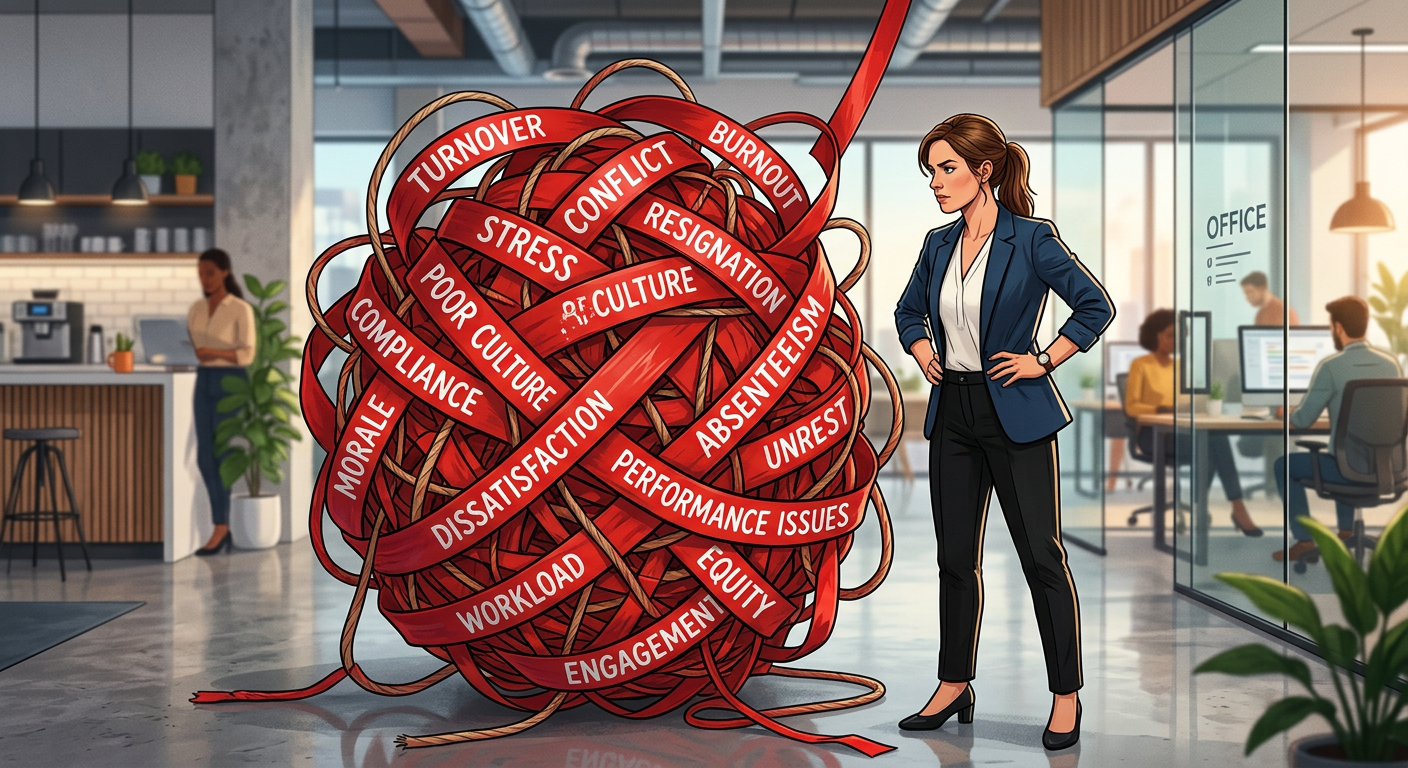
The Problem Usually Isn’t New
A hiring issue.
An onboarding issue.
A reporting issue.
A manager conflict.
It gets addressed.
Things improve temporarily.
Then months later, the same issue appears again.
Maybe in a different department.
Maybe with a different manager.
Maybe in a different form.
But it is still the same underlying problem.
Why HR Problems Repeat
Most recurring HR issues are not caused by isolated mistakes.
They are caused by structural gaps.
When the underlying process, workflow, or ownership is never addressed, the issue continues to resurface.
The symptom changes.
The root cause stays the same.
What Companies Often Do Instead
Many organizations respond reactively.
They:
- fix the immediate issue
- create a temporary workaround
- rely on individuals to manage around the problem
This creates short-term relief.
But not long-term stability.
Common HR Problems That Keep Reappearing
The pattern is usually predictable.
1. Inconsistent Hiring
The issue appears as:
- poor candidate experiences
- delayed hiring decisions
- inconsistent interview processes
The real problem is often:
- lack of standardized hiring workflows
- unclear role ownership
- inconsistent evaluation criteria
Without structure, hiring varies by manager.
2. Onboarding Problems
The issue appears as:
- missing equipment or access
- inconsistent training
- confused new hires
The real problem is often:
- onboarding is not documented
- workflows are manual
- responsibilities are unclear
The process depends on people remembering tasks instead of systems supporting them.
3. Reporting and Data Issues
The issue appears as:
- reports not matching
- difficulty finding accurate data
- manual spreadsheet work
The real problem is often:
- inconsistent data entry
- fragmented systems
- lack of data governance
According to research from Gartner, organizations struggle to make effective workforce decisions when HR data and processes are inconsistent.
Source
Gartner HR Technology Research - https://www.gartner.com/en/human-resources
4. Compliance Problems
The issue appears as:
- missing documentation
- outdated policies
- inconsistent recordkeeping
The real problem is often:
- compliance is tracked manually
- workflows are not standardized
- ownership is unclear
Compliance becomes reactive instead of operational.
5. Manager-Driven Inconsistency
The issue appears as:
- employees having different experiences across teams
- policies applied differently
- varying levels of documentation
The real problem is often:
- processes are not standardized
- managers create their own workflows
The organization becomes dependent on individuals instead of structure.
Why Temporary Fixes Don’t Last
Temporary fixes often focus on symptoms.
Examples include:
- adding another tool
- sending another reminder
- manually correcting issues repeatedly
But if the process itself remains unclear, the problem returns.
The Real Cause: Lack of Operational Structure
Most recurring HR issues are operational problems.
Not technology problems.
Not isolated employee problems.
Operational problems.
This includes:
- unclear workflows
- inconsistent ownership
- fragmented systems
- lack of process alignment
According to research from Deloitte, organizations that align processes, systems, and governance are more effective in managing workforce operations long term.
Source
Deloitte Human Capital Trends - https://www2.deloitte.com/us/en/insights/focus/human-capital-trends.html
If This Is Happening in Your Business, the Root Cause May Never Have Been Addressed
These are common indicators of recurring structural issues:
- the same HR problems continue appearing
- managers handle situations differently
- manual workarounds are common
- systems are underutilized
- employees receive inconsistent experiences
If several of these are true, the issue is likely structural—not isolated.
What Actually Solves Recurring HR Problems
Long-term improvement requires more than fixing symptoms.
It requires structure.
Define and Standardize Processes
Ensure workflows are:
- documented
- repeatable
- consistently followed
Establish Clear Ownership
Define who is responsible for:
- processes
- approvals
- compliance
- system management
Align Systems With Operations
Systems should support processes, not operate separately from them.
Reduce Manual Dependency
The more processes rely on memory and individual workarounds, the more likely issues are to repeat.
Focus on Root Causes
Before solving a problem, ask:
- why did this happen
- what process allowed it
- what structure is missing
How HRLaunch Technology Helps
At HRLaunch Technology, we help organizations identify and resolve the structural issues behind recurring HR problems.
Many businesses spend years addressing symptoms without addressing the operational gaps causing them.
Our approach focuses on:
- evaluating current HR operations and workflows
- identifying inconsistencies and process gaps
- designing structured, repeatable workflows
- aligning systems, data, and operational ownership
We work with small, mid-sized, and growing businesses to build HR functions that are consistent, scalable, and operationally aligned.
The goal is not just to fix individual problems.
It is to prevent them from continuing to return.
Final Thoughts
Recurring HR problems are rarely random.
They are usually signals.
Signals that structure, ownership, or workflows are not fully aligned.
Temporary fixes may reduce the immediate issue.
But lasting improvement comes from addressing the operational foundation underneath it.
That is what stops the same problems from coming back again and again.