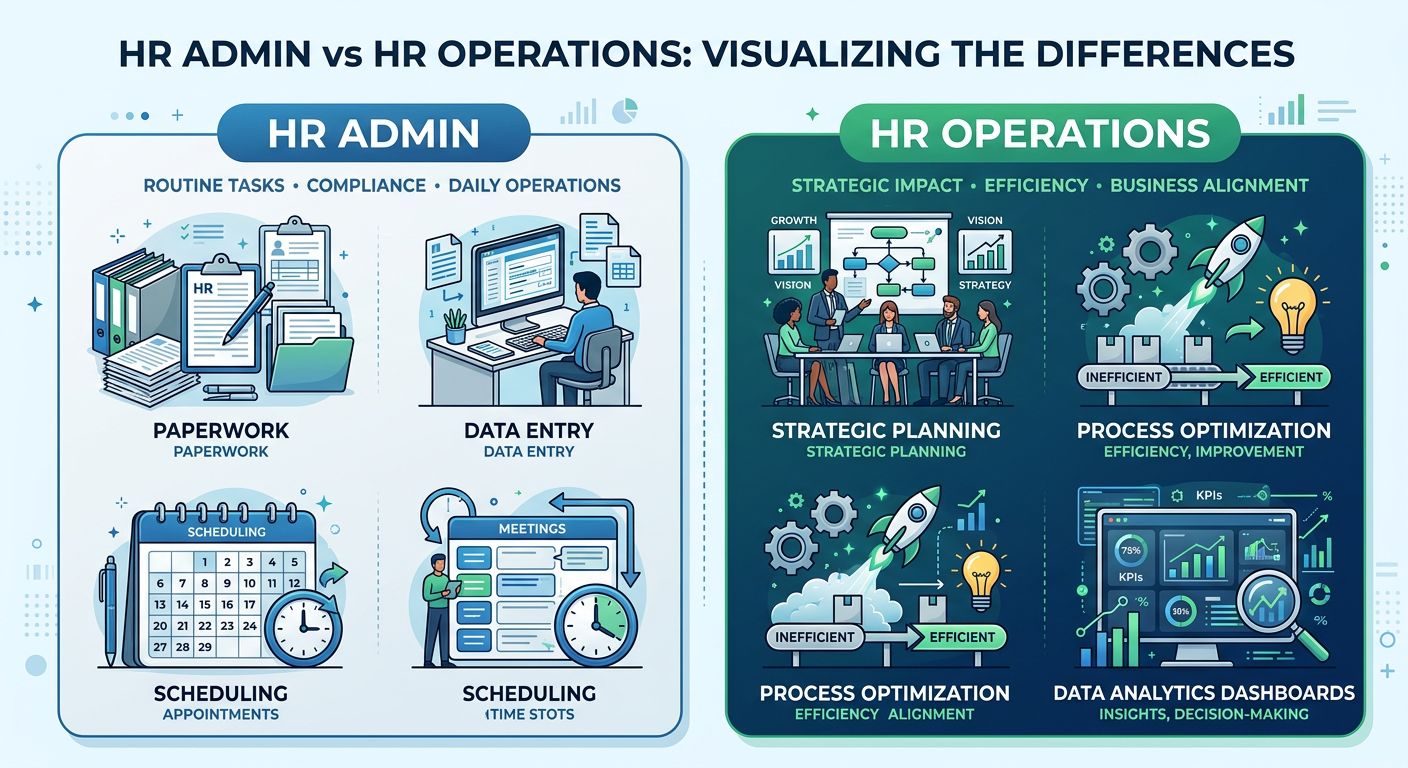
HR Administration and HR Operations Are Not the Same
In many small and growing businesses, all HR work gets grouped together.
Payroll.
Onboarding.
Employee questions.
Policies.
It is all labeled as “HR.”
But there is an important distinction that many organizations miss:
HR administration and HR operations are not the same thing.
And understanding that difference becomes critical as the business grows.
What HR Administrative Work Is
HR administrative work focuses on completing tasks and maintaining day-to-day activities.
This includes:
- processing payroll
- managing employee paperwork
- updating employee records
- responding to HR questions
- handling benefits administration
Administrative work is necessary.
It keeps the organization functioning.
What HR Operations Is
HR operations focuses on how HR functions across the organization.
It is concerned with:
- process structure
- workflow consistency
- system alignment
- operational efficiency
- scalability
HR operations is not just about doing HR tasks.
It is about building the structure behind them.
The Simplest Way to Understand the Difference
HR Administration Asks:
“How do we complete this task?”
HR Operations Asks:
“How should this process function consistently across the business?”
That difference changes everything.
What This Looks Like in Practice
The distinction becomes easier to see through examples.
Example 1: Onboarding
HR Administration
- sends onboarding paperwork
- schedules orientation
- enters employee information into the system
HR Operations
- designs the onboarding workflow
- defines ownership and approvals
- standardizes the process across departments
- aligns onboarding with systems and reporting
One executes the process.
The other builds and improves it.
Example 2: Payroll
HR Administration
- processes payroll
- updates deductions
- resolves payroll questions
HR Operations
- structures payroll workflows
- aligns payroll with HR systems
- improves approval processes
- ensures scalability and consistency
Example 3: Compliance
HR Administration
- files documentation
- tracks training completion
- updates employee records
HR Operations
- designs compliance workflows
- creates tracking structure
- standardizes documentation processes
- reduces compliance risk operationally
Why This Difference Matters More as Companies Grow
At smaller company sizes, administrative work often feels sufficient.
But growth changes the environment.
As organizations scale:
- more managers become involved
- more employees require support
- more workflows need consistency
Without operational structure:
- processes vary across teams
- manual work increases
- systems become fragmented
What once worked informally becomes difficult to manage.
The Common Mistake Growing Companies Make
Many organizations believe they have “HR covered” because administrative tasks are being completed.
Payroll runs.
Employees are onboarded.
Benefits are active.
But underneath that activity:
- workflows may not be standardized
- ownership may be unclear
- systems may not be aligned
- reporting may be unreliable
The work is being handled.
The operation is not fully structured.
Why HR Operations Creates Long-Term Stability
Strong HR operations creates:
- consistency across teams
- repeatable workflows
- scalable processes
- reliable reporting
- reduced operational friction
According to research from Gartner, organizations that align HR processes, systems, and governance improve operational effectiveness and workforce visibility.
Source
Gartner HR Technology Research - https://www.gartner.com/en/human-resources
Signs Your Company Has HR Administration but Not HR Operations
These are common indicators:
- processes vary by manager
- onboarding differs across departments
- workflows rely heavily on manual reminders
- reporting requires spreadsheet cleanup
- systems are underutilized
- HR depends heavily on specific individuals
If several of these are true, administrative work is likely happening without operational structure behind it.
How to Shift From HR Administration to HR Operations
The goal is not to eliminate administrative work.
It is to build structure around it.
Standardize Core Processes
Focus on:
- hiring
- onboarding
- approvals
- employee lifecycle workflows
Define Ownership
Clarify who owns:
- workflows
- systems
- compliance processes
- reporting
Align Systems With Processes
Technology should support operational workflows consistently across the organization.
Reduce Manual Dependency
The more processes rely on memory and workarounds, the harder they become to scale.
Focus on Scalability
Build processes that work not only for today, but for future growth.
According to research from Deloitte, organizations that operationalize HR processes are more effective at supporting long-term workforce growth and business alignment.
Source
Deloitte Human Capital Trends - https://www2.deloitte.com/us/en/insights/focus/human-capital-trends.html
How HRLaunch Technology Helps
At HRLaunch Technology, we help organizations move beyond simply handling HR tasks and toward building structured HR operations.
Many businesses reach a point where administrative work alone is no longer enough to support growth.
Our approach focuses on:
- evaluating current HR workflows and operational gaps
- designing structured, repeatable HR processes
- improving workflow consistency across teams
- aligning systems, reporting, and operational ownership
We work with small, mid-sized, and growing businesses to build HR functions that are scalable, operationally aligned, and built for long-term growth.
The goal is not just to complete HR tasks.
It is to create HR operations that function consistently across the business.
Final Thoughts
HR administration keeps the business moving.
HR operations helps it scale.
As organizations grow, the difference becomes more important.
Completing HR tasks is necessary.
But without operational structure behind those tasks, inefficiency and inconsistency eventually appear.
The businesses that scale effectively are the ones that build HR operations—not just HR activity.