More Tools Doesn’t Mean Better HR
When HR challenges arise, many organizations look for solutions in new tools.
A new platform.
A new system.
A new feature.
It feels like progress.
But over time, adding more tools often creates more problems than it solves.
How Tool Overload Happens
It rarely starts as a strategy.
It usually happens gradually.
- one tool is added to solve a specific issue
- another is introduced to fill a gap
- additional tools are layered on over time
Each decision makes sense on its own.
Together, they create complexity.
What This Looks Like in Practice
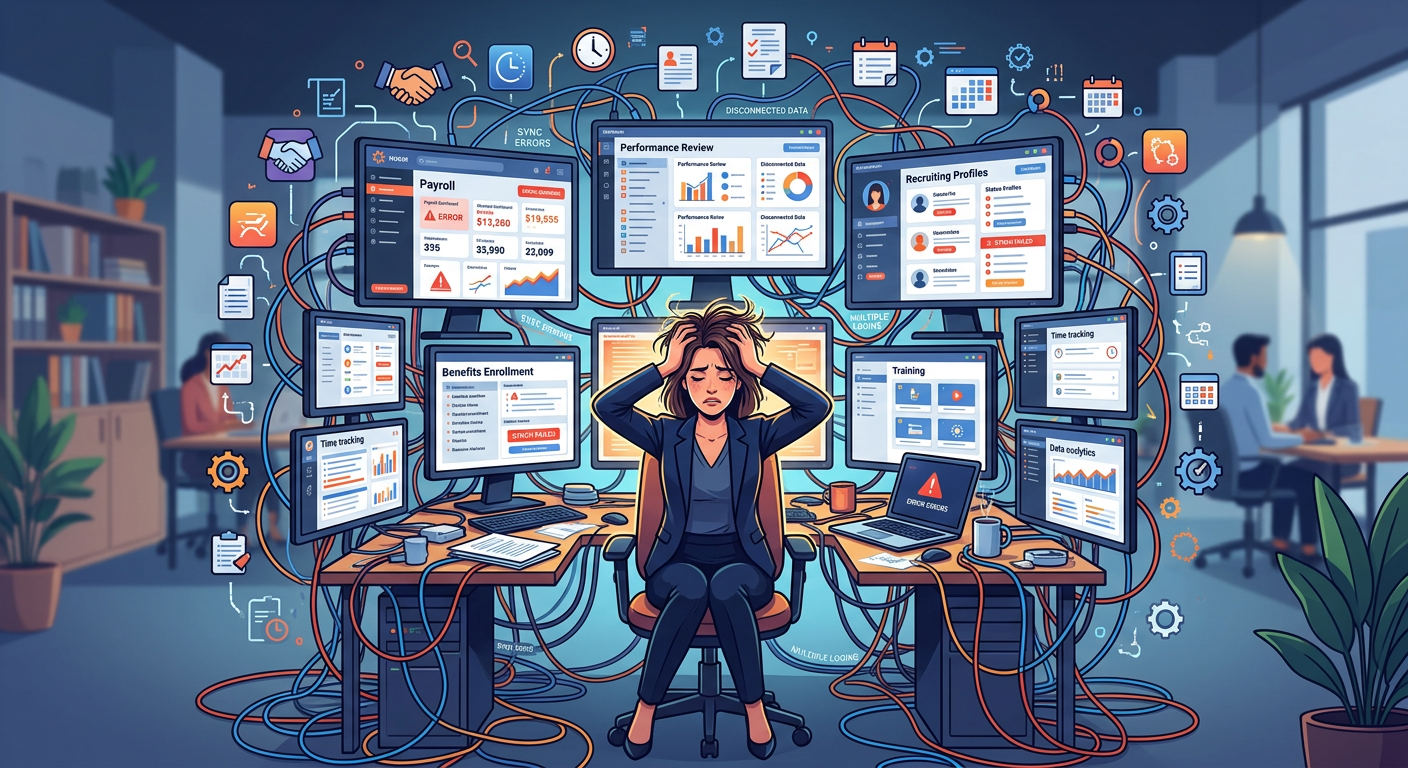
When too many HR tools are in place, the impact becomes visible in daily operations.
Data Is Spread Across Multiple Systems
Instead of having a single source of truth:
- employee data exists in different platforms
- updates are not applied consistently
- reporting becomes difficult
According to research from Gartner, fragmented systems reduce data accuracy and limit the ability to make informed decisions.
Source
Gartner HR Technology Research - https://www.gartner.com/en/human-resources
Workflows Become Disconnected
Different tools handle different parts of the same process.
This leads to:
- gaps between steps
- manual handoffs
- inconsistent execution
Processes become harder to manage.
Manual Work Increases Instead of Decreasing
More tools often require:
- duplicating data
- reconciling information across systems
- managing multiple logins and processes
Instead of reducing effort, complexity increases.
Reporting Becomes Unreliable
When data is not centralized:
- reports do not align
- metrics vary by system
- decision-making slows down
System Adoption Declines
When teams are required to use multiple tools:
- usage becomes inconsistent
- workarounds increase
- systems are underutilized
According to research from PwC, organizations struggle to realize value from HR technology when systems are not aligned with processes.
Source
PwC Workforce of the Future - https://www.pwc.com/us/en/services/consulting/workforce-of-the-future.html
Why Adding More Tools Feels Like the Right Move
Even when complexity increases, adding tools still feels like progress.
Common reasons include:
- trying to solve immediate problems quickly
- assuming new tools will fix existing issues
- responding to gaps without evaluating root causes
- following what other companies are using
The focus becomes solving symptoms, not the underlying problem.
The Real Issue: Lack of Alignment
The problem is not the number of tools.
It is the lack of alignment between:
- systems
- processes
- data
When these elements are not aligned, adding more tools increases fragmentation.
If This Is Happening in Your Business, You May Have Too Many Tools
These are common indicators of tool overload:
- employee data exists in multiple systems
- workflows require manual handoffs between tools
- reports need to be combined or cleaned manually
- teams rely on spreadsheets alongside systems
- different teams use different tools for similar functions
If several of these are true, the issue is not missing tools.
It is too many unaligned tools.
What to Do Instead
Improving HR operations does not always require adding more tools.
In many cases, it requires simplifying.
Consolidate Where Possible
Reduce the number of systems performing similar functions.
Align Systems With Processes
Ensure tools support how your business actually operates.
Centralize Data
Establish a single source of truth for employee information.
Optimize What You Already Have
Many organizations can improve outcomes by:
- better configuring existing systems
- using features that are already available
- improving adoption
Evaluate Before Adding
Before introducing a new tool, ask:
- what problem are we solving
- can our current system handle this
- will this create additional complexity
How HRLaunch Technology Helps
At HRLaunch Technology, we help organizations simplify their HR technology environment by focusing on alignment before expansion.
Many companies add tools to solve immediate problems, only to create fragmentation over time.
Our approach focuses on:
- evaluating the current HR tech stack and how it is being used
- identifying overlap, inefficiencies, and gaps
- aligning systems with workflows and business operations
- optimizing existing tools before recommending new ones
We work with small, mid-sized, and growing businesses to build HR environments that are structured, efficient, and scalable.
When new tools are needed, we ensure they are selected and implemented in a way that supports long-term alignment.
The goal is not to have more tools.
It is to have the right tools, working together effectively.
Final Thoughts
Adding more HR tools often feels like progress.
But without alignment, it increases complexity.
The goal is not to build a larger tech stack.
It is to build a better one.
When systems, processes, and data are aligned, fewer tools can deliver better results.