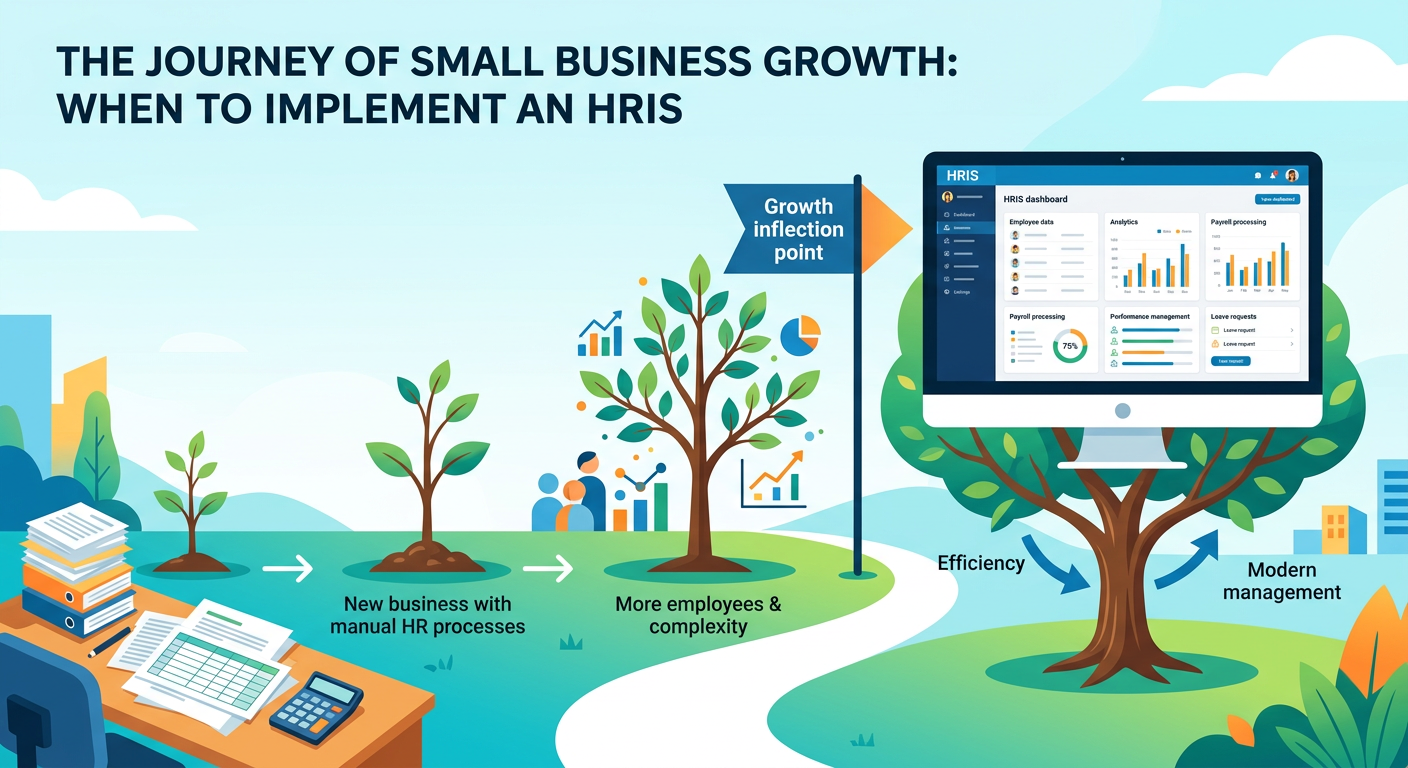
The Question Most Growing Businesses Ask Too Late
At some point, every growing business hits the same moment:
HR tasks start taking longer.
Hiring becomes harder to manage.
Payroll gets more complex.
And the question comes up:
Do we need an HR system?
For many companies, the answer is yes—but timing matters more than most realize.
Why Companies Rush Into HR Systems
Small businesses often feel pressure to implement an HRIS earlier than they should.
This pressure usually comes from:
- rapid employee growth
- increasing administrative workload
- compliance concerns
- the desire to “professionalize” HR operations
HR systems are often seen as the solution to these challenges.
But implementing a system too early—or without preparation—can create more problems than it solves.
Signs Your Business Is Ready for an HRIS
There are clear indicators that a company is ready to benefit from an HR system.
You Have 20–30+ Employees
At this stage, manual processes begin to break down.
Tracking employee data, onboarding, and time off through spreadsheets becomes inefficient and error-prone.
Payroll Has Become More Complex
You may be dealing with:
- multiple pay structures
- hourly and salaried employees
- multi-state payroll
- benefits deductions
An HRIS with integrated payroll can significantly reduce errors and administrative time.
Hiring and Onboarding Are Inconsistent
If onboarding varies by manager or location, it can lead to:
- inconsistent employee experiences
- missed documentation
- compliance risks
HR systems help standardize these processes.
Compliance Is Becoming a Concern
As your workforce grows, so do your compliance obligations.
This includes:
- employee documentation
- policy acknowledgments
- benefits tracking
- labor law requirements
An HRIS can centralize and track these elements more effectively.
You Need Better Visibility Into Your Workforce
Leadership teams often reach a point where they need data to make decisions.
Examples include:
- headcount tracking
- turnover rates
- compensation analysis
HR systems provide reporting and visibility that manual processes cannot.
Signs It’s Too Early to Implement an HRIS
Just as important as knowing when to implement a system is knowing when not to.
You Don’t Have Defined HR Processes
If your business has not clearly defined:
- hiring workflows
- onboarding steps
- approval processes
- employee lifecycle management
A system will only reflect that lack of structure.
There Is No Clear Ownership of HR
If no one is responsible for HR operations, the system will lack direction.
This often leads to:
- inconsistent data
- incomplete configuration
- underutilized features
Your Employee Data Is Inconsistent
If employee information is scattered across spreadsheets, emails, and different systems, implementing an HRIS without cleaning that data can create long-term issues.
You Are Trying to “Fix” HR With Software
HR systems are often purchased with the expectation that they will solve operational problems.
In reality, software supports processes—it does not create them.
The Risk of Implementing Too Early
Implementing an HRIS without proper readiness can lead to several challenges.
- poor system configuration
- low adoption by employees and managers
- manual workarounds outside the system
- wasted investment in unused features
- the need to replace the system sooner than expected
According to research from Gartner, HR technology implementations often fall short when organizations do not align systems with their internal processes.
Source
Gartner HR Technology Research - https://www.gartner.com/en/human-resources
What to Do Before You Implement an HRIS
Before selecting a platform, businesses should focus on preparation.
Define Your HR Workflows
Clearly outline how your organization handles:
- hiring and onboarding
- employee changes
- approvals and reporting
Clean and Organize Employee Data
Ensure that employee information is:
- accurate
- consistent
- centralized
Assign Ownership
Identify who is responsible for:
- system management
- data integrity
- ongoing optimization
Understand Your Requirements
Determine what your business actually needs from an HR system, including:
- payroll capabilities
- reporting requirements
- compliance tracking
- scalability
Why Timing Matters
An HRIS can be a powerful tool—but only when implemented at the right time and with the right foundation.
When companies align their processes, data, and ownership before implementation, they are far more likely to see:
- improved efficiency
- better data visibility
- consistent HR operations
- scalable systems that support growth
How HRLaunch Technology Helps
At HRLaunch Technology, we help small and growing businesses determine the right time to implement HR systems—and how to do it correctly.
Our services include:
- HRIS readiness assessments
- HR workflow alignment
- vendor-neutral HR system selection
- implementation planning and support
We focus on ensuring that HR systems are implemented with the structure needed to support long-term success.
Final Thoughts
The question is not just whether your business needs an HRIS.
It is whether your business is ready for one.
Implementing HR technology at the right time—with the right preparation—can create significant operational benefits.
Implementing it too early can create unnecessary complexity.
Understanding the difference is what sets successful HR systems apart.