Growth Exposes Gaps in HR
In the early stages, HR is often handled informally.
- hiring happens as needed
- onboarding is handled by managers
- employee issues are addressed case by case
This works for a while.
But as the organization grows, these informal approaches start to break down.
What used to be manageable becomes inconsistent.
And inconsistency creates risk.
Why HR Processes Matter More as You Grow
As teams expand:
- more managers are involved
- more employees require support
- more decisions are made daily
Without defined processes:
- outcomes vary
- efficiency decreases
- compliance risk increases
According to research from Gartner, organizations with structured HR processes are better positioned to scale operations and maintain consistency.
Source
Gartner HR Research - https://www.gartner.com/en/human-resources
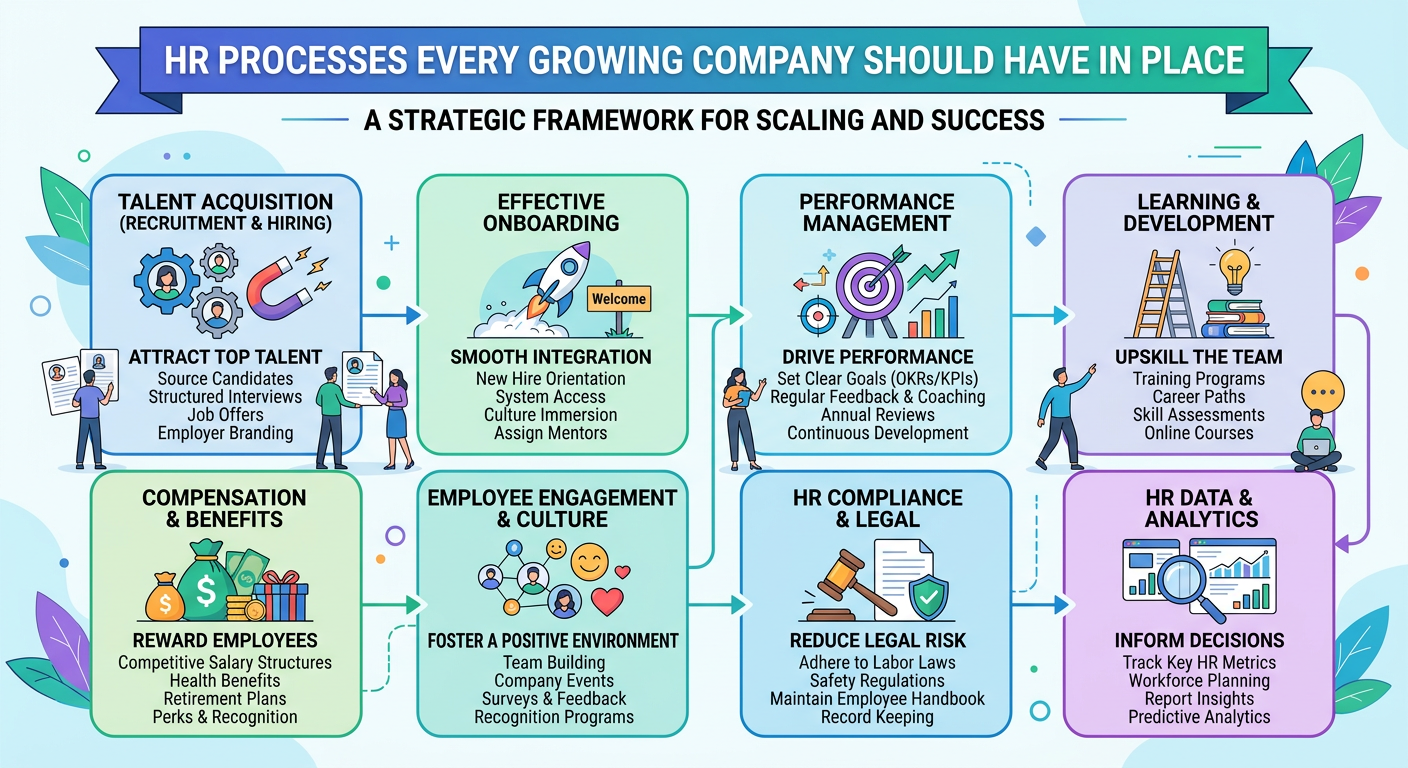
Core HR Processes Every Growing Company Needs
The goal is not to create complexity.
It is to create consistency.
1. Hiring and Recruitment Process
Hiring is one of the most critical HR functions.
A structured hiring process should include:
- defined role requirements
- standardized interview steps
- consistent evaluation criteria
- clear decision-making timelines
This improves hiring quality and speed.
2. Onboarding Process
Onboarding sets the foundation for employee success.
A strong onboarding process includes:
- structured first-day and first-week plans
- clear role expectations
- required documentation and compliance steps
- defined training and support
Consistency here improves retention and productivity.
3. Employee Lifecycle Management
Employees go through multiple stages during their time with a company.
This process should cover:
- promotions and role changes
- compensation adjustments
- performance management
- offboarding
Without structure, these changes become inconsistent.
4. Performance Management Process
Performance should not be addressed only when issues arise.
A structured process includes:
- regular check-ins
- defined evaluation criteria
- consistent feedback methods
- documentation of performance discussions
This supports better employee development and accountability.
5. Leave and Time-Off Management
Managing leave consistently is critical.
This includes:
- tracking time off
- applying policies consistently
- ensuring compliance with applicable laws
Without structure, errors and inconsistencies increase.
6. Compliance and Documentation Process
Compliance is not a one-time activity.
It requires ongoing management.
A structured process should include:
- maintaining required documentation
- tracking compliance-related activities
- ensuring policies are applied consistently
According to the U.S. Department of Labor, employers are responsible for maintaining proper records and compliance practices.
7. Employee Issue Resolution Process
Employee concerns and issues will arise.
A clear process ensures:
- consistency in handling situations
- proper documentation
- timely resolution
Without structure, responses can vary widely.
8. Data Management and Reporting Process
As organizations grow, data becomes more important.
A structured process should include:
- consistent data entry
- centralized data storage
- reliable reporting
This supports better decision-making.
9. Learning and Development Process
As companies grow, developing employees becomes just as important as hiring them.
A structured learning and development process should include:
- role-based training plans
- ongoing skill development
- leadership development for managers
- tracking training completion and progress
Why it matters:
- improves employee performance
- supports internal growth and promotions
- increases retention
Without a defined approach, development becomes inconsistent and reactive.
10. Compensation and Benefits Process
Compensation and benefits must be structured as the organization grows.
A strong process should include:
- defined compensation ranges by role
- consistent approach to raises and promotions
- benefits eligibility and administration
- alignment between pay, performance, and market data
Why it matters:
- ensures internal equity
- improves employee satisfaction
- supports better hiring and retention decisions
Without structure, compensation decisions become inconsistent and difficult to manage.
What Happens Without These Processes
When these processes are not in place:
- managers create their own approaches
- employee experiences vary
- decisions take longer
- manual work increases
Over time, this leads to inefficiency and risk.
If This Is Happening in Your Business, Processes May Be Missing
These are common indicators that key HR processes are not fully defined:
- hiring varies by manager
- onboarding is inconsistent
- employee changes are handled differently
- policies are applied inconsistently
- data is unreliable or fragmented
If several of these are true, the issue is not workload.
It is structure.
How to Build the Right Processes
Building HR processes does not require starting from scratch.
It requires clarity and alignment.
Start With How Things Actually Work
Understand current workflows before designing new ones.
Standardize Where It Matters
Focus on consistency in key areas like hiring, onboarding, and compliance.
Keep Processes Practical
Processes should be easy to follow and scalable.
Align Systems With Processes
Ensure systems support how processes are designed.
How HRLaunch Technology Helps
At HRLaunch Technology, we help organizations build the HR processes needed to support growth and consistency.
Many growing companies reach a point where informal HR practices no longer work, but structured processes have not yet been established.
Our approach focuses on:
- evaluating current HR operations and identifying gaps
- designing clear, repeatable workflows
- standardizing processes across teams and managers
- improving how HR functions day to day
We work with small, mid-sized, and growing businesses to build practical, scalable HR foundations, even when HR is managed by a single individual or an operations-led team.
When systems are involved, we ensure they support these processes through proper configuration, data alignment, and workflow design.
The goal is not to create complexity.
It is to create consistency across all areas of the employee lifecycle.
Final Thoughts
Growth makes HR more important.
It also makes gaps more visible.
The difference between organizations that struggle and those that scale effectively often comes down to processes.
When the right processes are in place, HR becomes consistent, efficient, and aligned with the business.
That is what allows it to support growth instead of slowing it down.