Your New Location Is Almost Ready. Is HR?
Imagine your company has spent months preparing to open a second location.
The lease is signed.
Equipment has been ordered.
Managers have been selected.
Hiring has started.
Opening day is six weeks away.
Then someone asks:
"Who is handling HR for the new location?"
Suddenly, questions start appearing.
Will new employees follow the same onboarding process?
Who approves their timecards?
Does the employee handbook apply in this location?
Who is responsible for posting required labor notices?
Will payroll correctly handle employees working in another state?
Does your existing HR system support the new location?
What happens when employees have HR questions?
Expansion plans often focus heavily on facilities, operations, customers, equipment, and staffing.
HR is sometimes treated as something that can simply be copied from the existing location.
But opening another location does more than increase headcount.
It adds another layer of operational and, depending on where you expand, legal complexity.
Why Expansion Exposes HR Problems
Your HR processes may work perfectly well today.
That doesn't necessarily mean they're scalable.
Consider a company with 60 employees working from one location.
The Office Manager personally coordinates onboarding.
Managers walk paperwork to their office.
Payroll questions are resolved face-to-face.
Employee files are maintained locally.
The owner approves compensation changes.
None of that necessarily feels broken.
Now open another facility 300 miles away.
Suddenly:
- paperwork can't simply be walked down the hallway
- HR can't personally remind every manager about missing documents
- employees can't stop by the office with questions
- managers need clearer instructions
- local requirements may differ
- approvals need to work remotely
The second location didn't create the problem.
It exposed a process that depended on proximity rather than structure.
The Five Areas to Review Before Expanding
Before opening another location, evaluate HR across five areas:
1. Compliance
What legal requirements change because of where employees will work?
2. Processes
Can existing HR workflows operate consistently across locations?
3. Ownership
Who is responsible for HR activities at the new location?
4. Technology
Can your systems support multiple locations without creating manual work?
5. Management
Are local managers prepared to execute HR processes consistently?
If any of these areas are unclear before opening, they usually become harder to resolve afterward.
1. Start With the Location, Not Your Existing Handbook
One of the biggest mistakes businesses can make is assuming the HR practices used at one location automatically apply everywhere else.
If you're opening in another state, this becomes especially important.
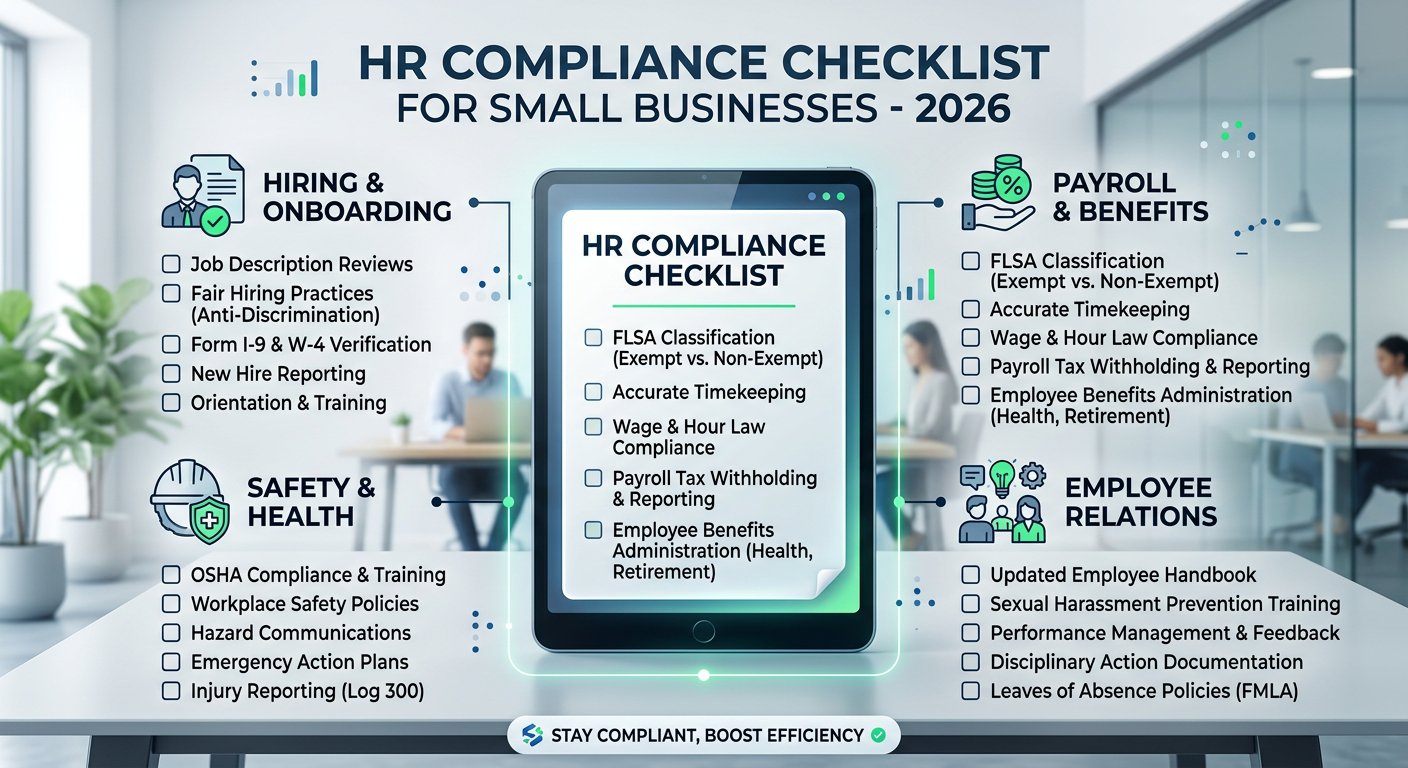
Federal employment requirements may apply across the organization, but states and local jurisdictions can establish additional requirements involving areas such as:
- minimum wage
- overtime
- paid sick leave
- meal and rest periods
- final pay
- required workplace notices
- leave
- pay transparency
- employee recordkeeping
The U.S. Department of Labor maintains a state labor office directory because many employment requirements are administered at the state level in addition to federal requirements.
A business expanding from Tennessee into California, for example, cannot simply assume its Tennessee employment practices will satisfy California requirements.
Even expansion into another city can require additional review because some local governments maintain employment-related requirements.
What to Review
Before employees begin working at the new location, identify:
- federal requirements that apply
- applicable state requirements
- applicable local requirements
- required workplace posters and notices
- whether existing policies need location-specific additions
- payroll and tax registration requirements
Don't wait until an employee asks a question to discover that your existing policy doesn't address their location.
2. Test Whether Your Hiring Process Actually Scales
A second location often means increased hiring.
That can expose recruiting processes that were manageable only because hiring volume was previously low.
Imagine your current process is:
- A manager emails the Office Manager when they need someone.
- The Office Manager posts the position.
- Resumes are emailed to the manager.
- Interviews happen whenever schedules allow.
- Someone tells the Office Manager which candidate they want.
- An offer letter is created.
That may work for five hires a year.
It becomes much harder when you're hiring 25 people for a new location simultaneously.
Before Hiring Begins, Define:
- who approves new positions
- who creates job postings
- who reviews candidates
- who conducts interviews
- what interview questions will be used
- who approves compensation
- who extends offers
- where candidate documentation is maintained
This isn't bureaucracy.
It's preventing hiring volume from turning into hiring chaos.
3. Build One Onboarding Process Before You Have Two
Opening another location should not create another version of onboarding.
Consider two employees starting the same job at different locations.
At Location A:
Their equipment is ready.
Paperwork is completed electronically.
Training is scheduled.
Their manager has a first-week plan.
At Location B:
The manager didn't know which forms were required.
Equipment hasn't arrived.
The employee spends the morning waiting.
Training gets scheduled "later."
Those employees technically work for the same company.
But they're experiencing two different organizations.
Your Core Onboarding Process Should Define:
- pre-employment requirements
- employment documentation
- payroll enrollment
- benefits information
- policy acknowledgments
- equipment and access
- required training
- manager responsibilities
- first-week expectations
- follow-up checkpoints
There may be legitimate location-specific differences.
The core process, however, should remain consistent.
4. Decide Who Owns HR at the New Location
This question sounds simple until you actually ask it.
Who handles HR?
Corporate?
The new location manager?
The Office Manager?
Someone onsite?
A combination?
Without clear ownership, responsibilities often migrate to whoever happens to notice something needs to be done.
Instead, create an ownership model.
| Responsibility | Central HR/Operations | Location Manager |
| Maintain HR policies | Own | Follow |
| Employee onboarding administration | Coordinate | Execute assigned steps |
| Daily employee supervision | Support | Own |
| Performance conversations | Guide | Own |
| Employee documentation | Maintain process | Complete required documentation |
| HRIS administration | Own | Complete manager actions |
| Compliance tracking | Coordinate | Support local execution |
| Employee questions | Support | Handle appropriate day-to-day questions |
Your exact model may differ.
What matters is that everyone knows the model before employees arrive.
5. Review Whether Your HR Technology Supports Multiple Locations
Your HRIS may have worked perfectly for one location.
Expansion creates new questions.
Can the system:
- assign employees to different locations?
- apply appropriate policies?
- route approvals to different managers?
- track location-specific documents?
- provide location-level reporting?
- support different timekeeping requirements?
- assign training based on employee location?
If not, HR may begin creating workarounds.
And workarounds multiply quickly.
A spreadsheet appears for Location B.
Someone creates a separate onboarding checklist.
Payroll keeps another tracking file.
Managers start emailing changes.
Soon you don't have one HR process supporting two locations.
You have two HR processes.
6. Don't Forget Payroll and Tax Administration
Adding employees in another jurisdiction can create payroll responsibilities that businesses may not encounter at their original location.
The IRS explains that employers generally have responsibilities for withholding, depositing, reporting, and paying employment taxes.
State requirements can add another layer.
Before expansion, confirm whether you need:
- state employer registration
- unemployment insurance registration
- new payroll tax setup
- location-specific withholding
- workers' compensation changes
- updated payroll configurations
This should be addressed before the first payroll involving employees at the new location.
Payroll should never discover expansion because someone notices an unfamiliar work address.
7. Your Managers Become Even More Important
At one location, HR can compensate for an inexperienced manager.
At multiple locations, that becomes harder.
Suppose a manager at your original location knows that employee performance concerns should be documented and discussed with HR.
The new location manager doesn't.
They verbally coach an employee five times.
Nothing is documented.
Six months later, the company wants to take further action.
HR discovers there is almost no record of what occurred.
The problem isn't necessarily the manager.
The organization never gave the manager the process.
Before opening, managers should understand:
- hiring responsibilities
- onboarding expectations
- documentation standards
- attendance processes
- performance management
- when HR should be involved
- what decisions require approval
- where documentation belongs
A new location needs more than an operational leader.
It needs a manager who understands how your people processes work.
Quick Win: Run a "Location Two" Test
You don't need to wait until expansion to find weaknesses.
Pick one employee at your existing location and pretend they're starting at a facility 500 miles away tomorrow.
Now walk through their entire employee experience.
Hiring
Could the candidate complete the process without visiting your current office?
Onboarding
Could every document, approval, training assignment, and system setup happen without someone physically walking paperwork between departments?
Management
Would a new manager know exactly what they own?
Employee Support
Would the employee know where to go with payroll, benefits, policy, or HR questions?
Compliance
Could you determine which requirements apply based on where that employee works?
Offboarding
Could you consistently terminate system access, retrieve equipment, complete documentation, and process the employee's departure remotely?
Every point where you answer:
"We would have to figure that out."
is something worth addressing before expansion.
Common Mistakes Businesses Make When Opening New Locations
Copying Existing Processes Without Testing Them
A process that works because everyone is in one building may fail when employees are distributed.
Allowing the New Location to Build Its Own HR Processes
Local flexibility can be valuable.
Creating an entirely separate HR operation usually isn't.
Waiting Until Employees Are Hired to Research Requirements
Compliance research should happen during expansion planning, not after opening day.
Assuming the HRIS Will Automatically Handle Everything
Technology needs to be configured for organizational changes.
Adding a location name to the system doesn't automatically create the workflows behind it.
Leaving HR Ownership Undefined
If corporate assumes the location manager is handling something while the location manager assumes corporate owns it, important responsibilities can be missed.
Questions to Ask Before You Open
Before finalizing your HR readiness, sit down with leadership, HR, operations, and the new location manager and answer:
- What HR requirements are different in this location?
- Which existing policies need review?
- Who owns each stage of hiring?
- Who owns onboarding?
- How will employee documentation reach HR?
- How will managers communicate employee changes?
- Who monitors compliance requirements?
- Can our HRIS support the location?
- Can payroll support employees there?
- What HR training does the location manager need?
- How will employees access HR support?
- What happens when the location grows from 10 employees to 50?
That last question matters.
Don't build the HR process only for opening day.
Build it for what the location is expected to become.
Recommendation Going Forward
If you're opening another location, HR readiness should be part of the expansion plan alongside facilities, technology, finance, staffing, and operations.
Start early.
Map the employee lifecycle from hiring through offboarding.
Determine what changes because of the new location, what should remain standardized across the company, and who will own each responsibility.
At HRLaunch Technology, we help small, mid-sized, and growing businesses build the HR infrastructure needed to support expansion.
That can include:
- evaluating existing HR operations before expansion
- identifying workflow and ownership gaps
- reviewing HR processes for multi-location scalability
- building standardized hiring and onboarding workflows
- improving employee lifecycle processes
- evaluating HRIS readiness
- implementing or optimizing HR technology when needed
- creating documentation and operational structure for the people responsible for HR
The objective isn't to create more process for the sake of process.
It's to prevent your second location from requiring a second version of HR.
Final Thoughts
Opening a new location is a sign that your business is growing.
Your HR infrastructure needs to grow with it.
Processes built around one office, one manager, or one person remembering what happens next may work today.
Expansion tests whether those processes are actually scalable.
The best time to discover they aren't is before the doors open.
Because when HR is properly structured, a new location doesn't require reinventing how your company manages people.
It requires extending a foundation that already works.
Sources
U.S. Department of Labor — State Labor Offices
https://www.dol.gov/agencies/whd/state/contacts
U.S. Department of Labor — Employment Laws Assistance for Workers and Small Businesses
https://www.dol.gov/general/aboutdol/majorlaws
Internal Revenue Service — Employment Taxes
https://www.irs.gov/businesses/small-businesses-self-employed/employment-taxes
Internal Revenue Service — Understanding Employment Taxes
https://www.irs.gov/businesses/small-businesses-self-employed/understanding-employment-taxes
U.S. Equal Employment Opportunity Commission — Small Business Requirements