HRIS Systems Are Powerful — But Not Always Simple
Human Resources Information Systems (HRIS) have become essential tools for businesses of all sizes. They help organizations manage employee data, payroll, benefits, compliance, and reporting in one centralized system.
But while HR technology has improved dramatically over the past decade, many companies still struggle to get the full value from their HRIS.
In fact, organizations frequently encounter the same challenges after implementing a system. These problems are rarely caused by the software itself. Instead, they usually stem from configuration issues, unclear processes, or poor system adoption.
Understanding the most common HRIS challenges can help organizations avoid costly mistakes and improve how their systems support HR operations.
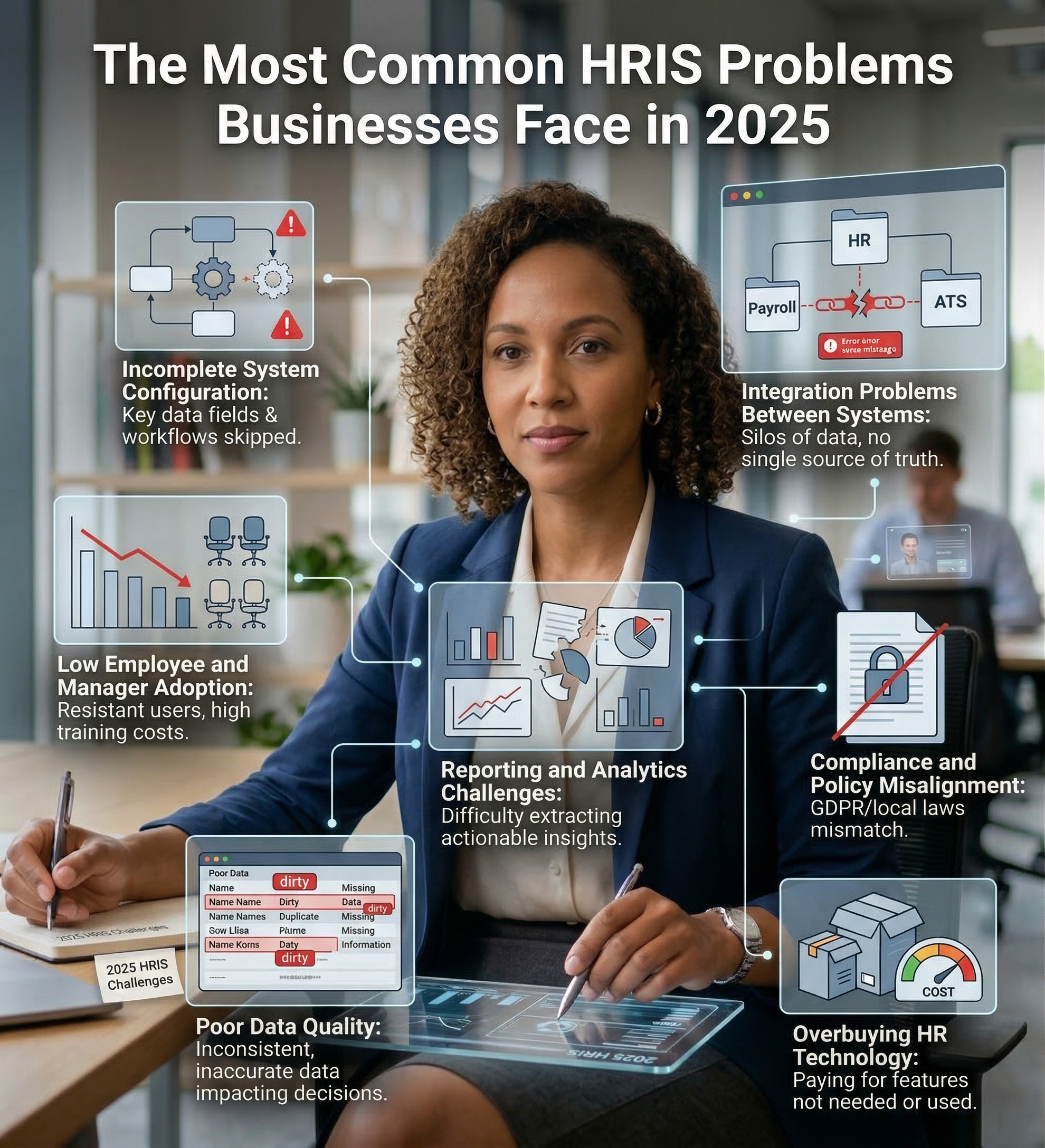
Incomplete System Configuration
One of the most common HRIS issues occurs during the initial implementation.
Many organizations configure only the basic functions needed to get the system running, such as payroll and employee records. More advanced features are often left unused or only partially configured.
This can lead to issues such as:
- Missing employee data fields
- Inconsistent approval workflows
- Limited automation of HR processes
- Reporting that requires manual data cleanup
Over time, these gaps create inefficiencies that undermine the purpose of implementing an HR system.
According to HR technology research from Gartner, poor implementation planning is one of the most common reasons HR technology projects fail to deliver expected outcomes.
Source:
Gartner HR Technology Research - https://www.gartner.com/en/human-resources
Low Employee and Manager Adoption
Even well-configured HRIS platforms can struggle if employees and managers do not fully adopt the system.
This often happens when:
- The system is difficult to use
- Employees were not properly trained
- Managers continue using older manual processes
When adoption is low, organizations often find themselves managing HR tasks both inside and outside the system.
Examples include:
- Managers approving requests via email instead of the HRIS
- HR teams are maintaining duplicate spreadsheets
- Employees bypassing self-service features
Low adoption reduces the efficiency gains that HR systems are meant to deliver.
A survey by Deloitte found that many organizations struggle with employee adoption when implementing new HR technology, especially when change management is not prioritized.
Source:
Deloitte Human Capital Trends - https://www2.deloitte.com/us/en/insights/focus/human-capital-trends.html
Poor Data Quality
An HRIS is only as valuable as the data it contains.
Many organizations discover that their employee data is inconsistent or incomplete after implementing a system. Data may have been imported from multiple spreadsheets, payroll systems, or manual records.
Common data issues include:
- Duplicate employee records
- Inconsistent job titles or department names
- Missing employee information
- Outdated employee status data
Poor data quality affects reporting accuracy and can create compliance risks if information used for regulatory reporting is incorrect.
Maintaining consistent HR data governance is essential for organizations that rely on HR systems for decision-making.
Reporting and Analytics Challenges
Many companies implement an HRIS expecting improved reporting and analytics capabilities. However, reporting often becomes one of the most frustrating aspects of HR technology.
Common reporting challenges include:
- Difficulty creating custom reports
- Data stored in multiple modules or systems
- Limited reporting flexibility
- Reports requiring manual adjustments
In many cases, HR teams still rely on spreadsheets to compile the reports they need.
According to research by PwC, organizations often struggle to extract actionable insights from HR technology because data structures and reporting frameworks were not clearly defined during implementation.
Source:
PwC HR Technology Survey - https://www.pwc.com/us/en/services/consulting/workforce-of-the-future.html
Integration Problems Between Systems
Many organizations use multiple business systems alongside their HRIS, including:
- Payroll providers
- Accounting systems
- recruiting platforms
- time and attendance software
When these systems do not integrate smoothly, data must be transferred manually.
Integration problems can lead to:
- Duplicate data entry
- inconsistent employee records
- delayed reporting
- payroll errors
As businesses grow, the number of connected systems increases, making integration planning more important during HRIS selection.
Compliance and Policy Misalignment
HRIS platforms often include features designed to help organizations manage compliance obligations. However, if company policies and workflows are not aligned with the system, compliance risks can still occur.
Examples include:
- Incorrect employee classification settings
- Outdated policies stored in the HR system
- Approval workflows that do not match compliance requirements
- Incomplete documentation for employee actions
Ensuring that HR policies and system configuration remain aligned is essential for maintaining compliance.
Overbuying HR Technology
Another growing trend in 2025 is that many companies purchase HR platforms that are far more complex than their current needs require.
While these systems offer powerful features, organizations sometimes struggle to fully utilize them.
This can result in:
- paying for features that are never used
- complex configurations that require ongoing management
- longer implementation timelines
For small and mid-sized businesses, choosing the right-sized HR system is often more effective than selecting the most feature-rich platform.
Why Many HRIS Problems Are Operational — Not Technical
A common misconception is that HRIS problems are caused by technology limitations.
In reality, most issues stem from operational challenges such as:
- unclear ownership of HR processes
- inconsistent workflows across departments
- poor data management practices
- limited internal expertise managing HR technology
When these operational issues are addressed, HR systems tend to perform much more effectively.
How HRLaunch Technology Helps
At HRLaunch Technology, we work with growing organizations to ensure their HR systems support their operations rather than complicate them.
Our services include:
- HRIS readiness assessments
- HRIS configuration reviews
- vendor-neutral HR system selection
- implementation guidance
- HR process alignment
By focusing on operational clarity first, organizations can get significantly more value from their HR technology.
Final Thoughts
HRIS systems have become essential tools for managing modern workforces. However, successful outcomes depend on more than simply purchasing software.
Organizations that invest time in proper configuration, data management, and user adoption are far more likely to see the efficiency and insight HR technology promises.
Understanding the most common HRIS challenges can help businesses avoid common pitfalls and build HR systems that truly support their growth.