Hiring Feels Harder Than It Should
Across the Southeast, many companies are facing the same challenge:
Roles are open longer.
Qualified candidates are harder to secure.
Hiring pipelines feel inconsistent.
The common assumption is that the talent pool has changed.
In reality, the issue is often simpler:
There is a growing gap between what the market expects and what companies are offering.
What the Market Is Actually Paying
Salary benchmarks from sources such as Robert Half and Salary.com show where compensation currently stands across key business functions.
Below are representative ranges for mid-level roles in 2025–2026.
HR (HR Generalist / HR Manager)
- Market Range: $70,000 – $105,000
- Market Midpoint: ~$87,500
HR roles have seen steady increases due to compliance complexity, employee relations demands, and multi-state workforce management.
IT (Systems Administrator / IT Manager / Security Roles)
- Market Range: $85,000 – $130,000
- Market Midpoint: ~$107,500
IT continues to command higher salaries due to cybersecurity risks, infrastructure demands, and increased reliance on technology.
Accounting (Staff / Senior Accountant)
- Market Range: $65,000 – $95,000
- Market Midpoint: ~$80,000
Accounting roles remain in high demand, particularly for candidates with multi-entity or audit experience.
Marketing (Marketing Manager / Digital Marketing)
- Market Range: $70,000 – $110,000
- Market Midpoint: ~$90,000
Marketing salaries vary widely based on digital expertise, analytics capability, and revenue impact.
Sources
Robert Half Salary Guide - https://www.roberthalf.com/us/en/insights/salary-guide
Salary.com Compensation Data - https://www.salary.com
What Companies Are Actually Offering
While market data reflects current compensation expectations, many job postings across platforms like LinkedIn and Indeed tell a different story.
In many cases, posted salary ranges are:
- based on outdated benchmarks
- constrained by pre-set budgets
- misaligned with role expectations
Typical observed ranges for similar roles:
- HR roles posted closer to $65K–$80K
- IT roles posted around $80K–$100K
- Accounting roles posted near $60K–$75K
- Marketing roles posted around $65K–$85K
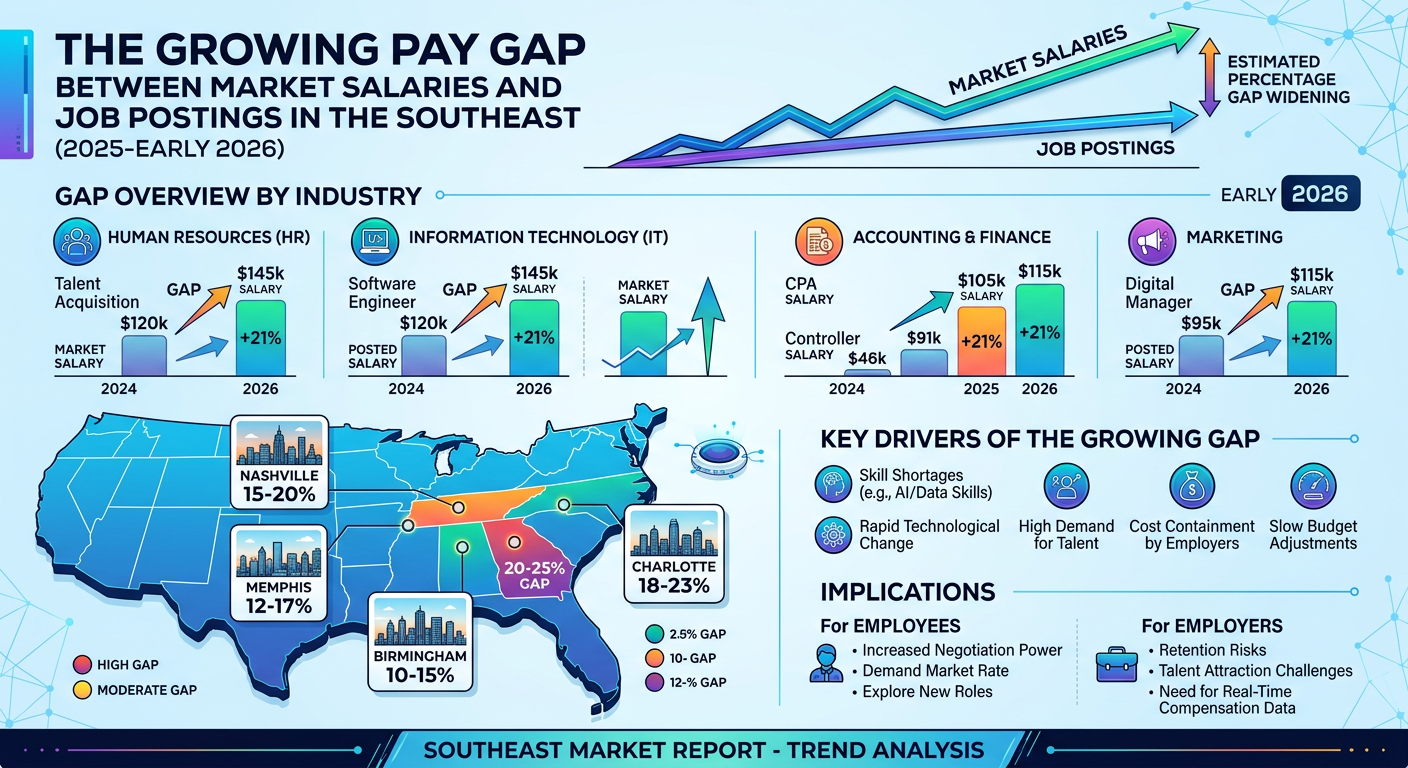
This creates a noticeable gap between market expectations and employer offerings.
Salary Gap Comparison
The gap becomes clearer when comparing midpoints.
| Role | Market Midpoint | Posted Midpoint | Gap |
| HR | $87,500 | $72,500 | ~17% |
| IT | $107,500 | $90,000 | ~16% |
| Accounting | $80,000 | $67,500 | ~16% |
| Marketing | $90,000 | $75,000 | ~17% |
Across functions, the gap consistently falls between 15% and 20%.
What This Looks Like Across the Southeast
While compensation varies by city, the misalignment trend is consistent.
Nashville
- Strong job market with rising salary expectations
- Many postings lag behind due to rapid growth
Atlanta
- Competitive market with higher salary benchmarks
- Gap still exists, especially in mid-level roles
Charlotte
- Financial and corporate hub driving higher pay expectations
- Companies often compete for the same talent pool
Memphis
- Lower cost of living, but still experiencing salary pressure
- Gap is often tied to outdated compensation assumptions
Birmingham
- Smaller market, but growing demand for skilled professionals
- Companies often struggle to balance budget and competitiveness
Why This Gap Exists
The disconnect between market salaries and job postings is not random. It is typically driven by several factors.
Outdated Salary Benchmarks
Many companies rely on compensation data that is 12–24 months old, which does not reflect current market conditions.
Budget Constraints
Organizations often set salary ranges based on internal budgets rather than external market realities.
Internal Equity Concerns
Adjusting salaries for new hires can create pressure to increase pay for existing employees, leading companies to keep ranges lower.
Misaligned Role Scope
Some job postings combine responsibilities from multiple roles without adjusting compensation accordingly.
Hiring Strategy Misalignment
Companies may “test the market” with lower salary ranges, expecting to adjust later. This often slows down the hiring process.
The Business Impact of Underpaying
The effects of this gap go beyond compensation.
Organizations may experience:
- longer time-to-fill for open roles
- Reduced candidate quality
- increased offer rejections
- Higher turnover after hiring
- additional strain on existing teams
Over time, these challenges can impact overall business performance.
What Companies Should Do Instead
Closing the gap does not always mean dramatically increasing salaries. It starts with better alignment.
Use Current Market Data
Regularly review updated salary benchmarks from reliable sources.
Align Pay With Role Expectations
If a role requires advanced skills or expanded responsibilities, compensation should reflect that.
Reevaluate Job Descriptions
Ensure roles are clearly defined and not combining multiple positions into one.
Track Hiring Metrics
Monitor:
- time-to-fill
- offer acceptance rates
- candidate drop-off points
These metrics provide insight into whether compensation is competitive.
Leverage HR Systems for Visibility
HRIS platforms can help organizations:
- track compensation trends
- analyze hiring performance
- Align pay with workforce data
How HRLaunch Technology Helps
At HRLaunch Technology, we help organizations align their HR systems and processes with real-world market conditions.
Our services include:
- HRIS readiness assessments
- compensation and reporting alignment
- HR technology selection and implementation
- workforce data visibility and analysis
We focus on helping businesses make informed decisions that improve hiring outcomes and operational efficiency.
Final Thoughts
The hiring challenges many companies face today are not always about talent shortages.
In many cases, they are about alignment.
When compensation reflects current market realities, organizations are better positioned to attract and retain the talent they need.
Understanding and addressing the gap between market salaries and job postings is a critical step toward building a more effective hiring strategy.