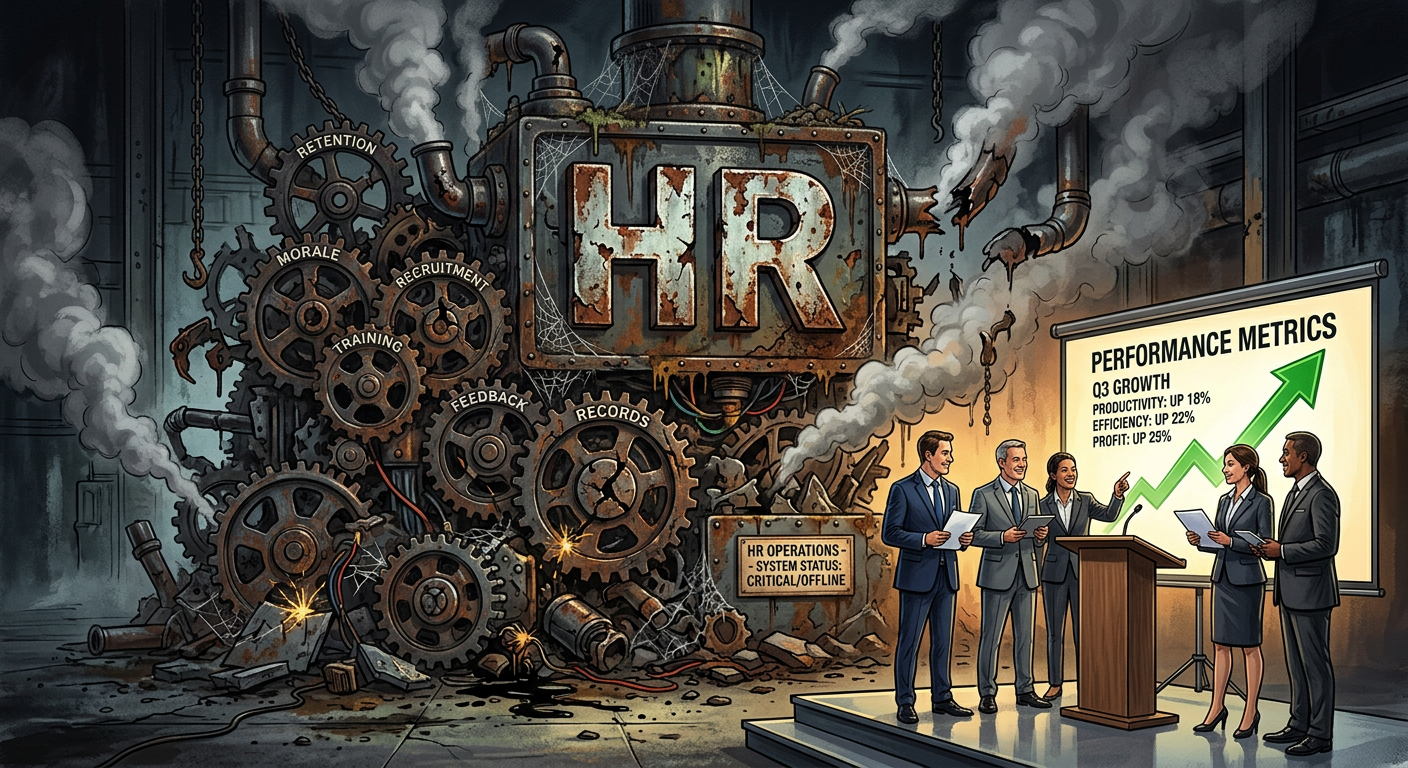
Broken HR Rarely Looks Broken
When a major system fails, everyone notices.
When revenue declines, leadership notices.
When operations stop functioning, the problem is obvious.
HR works differently.
Most HR issues do not announce themselves.
They develop gradually through:
- inconsistent processes
- manual workarounds
- unclear ownership
- fragmented systems
Over time, these issues become accepted as "the way things are."
Why Companies Miss the Signs
Most businesses do not intentionally neglect HR.
Instead, they become accustomed to inefficiencies.
What starts as a temporary solution becomes a permanent process.
What was manageable at 15 employees becomes problematic at 75.
What worked for a founder-led organization becomes difficult to sustain at scale.
The business adapts around the problem instead of fixing it.
The Most Common Misconception
Many organizations believe that if:
- payroll runs
- employees get hired
- benefits are active
- no major complaints exist
then HR must be functioning properly.
But activity is not the same as effectiveness.
HR can be busy every day and still be operating inefficiently.
Signs Your HR May Be Broken (Even If It Doesn't Feel Like It)
The warning signs are often operational rather than dramatic.
Managers Handle Everything Differently
One manager follows a structured hiring process.
Another skips half the steps.
One documents employee issues.
Another relies on memory.
When processes vary significantly by manager, HR is no longer operating consistently.
The organization is relying on individual habits instead of operational structure.
Employees Have Different Experiences
Employees should not have vastly different experiences based on:
- department
- location
- manager
Yet this often happens when workflows are not standardized.
Examples include:
- inconsistent onboarding
- uneven performance management
- different policy enforcement
These inconsistencies create frustration and risk.
The Business Runs on Spreadsheets
Spreadsheets are not inherently bad.
But when critical HR processes depend on them, problems emerge.
Common examples include:
- onboarding tracking
- compliance reminders
- employee records
- reporting
When key processes rely heavily on manual spreadsheets, scalability becomes difficult.
Leadership Lacks Workforce Visibility
Many companies struggle to answer basic workforce questions:
- How long does hiring take?
- What departments have the highest turnover?
- Where are compliance risks emerging?
- How effective is onboarding?
Without reliable workforce data, decisions become reactive.
According to Visier, workforce visibility remains one of the most significant challenges facing growing organizations because fragmented data limits decision-making effectiveness.
HR Systems Are Being Used, But Not Fully Utilized
A common assumption is:
"We have an HR system, so we're fine."
But many organizations:
- use only a fraction of available functionality
- continue managing workflows outside the platform
- maintain duplicate records
- manually perform automated tasks
The software exists.
The operational structure does not.
Compliance Depends on Memory
Compliance becomes risky when processes rely on:
- individual reminders
- calendar notes
- manual follow-up
Examples include:
- certification renewals
- policy acknowledgments
- training completion
- documentation requirements
According to the Society for Human Resource Management, organizations that lack structured compliance processes face significantly greater operational and legal risk.
Growth Creates More Problems Instead of More Opportunities
Healthy growth should improve organizational maturity.
But when HR is broken, growth often creates:
- more inconsistency
- more manual work
- more employee issues
- more management frustration
The organization becomes harder to operate as it grows.
Why Broken HR Often Gets Mistaken for Normal Growth Challenges
Many leaders assume the following are simply part of growing a business:
- hiring takes longer
- onboarding becomes inconsistent
- managers struggle with employee issues
- reporting becomes difficult
While growth certainly increases complexity, these issues are often symptoms of operational gaps—not growth itself.
According to research from APQC, organizations with standardized HR processes experience greater operational efficiency and consistency than organizations relying on informal workflows.
The Root Cause Is Usually Structure
When HR feels broken, the problem is rarely the people.
It is usually the structure behind the work.
This includes:
- unclear workflows
- undefined ownership
- inconsistent execution
- disconnected systems
Most HR problems are operational problems first.
If This Is Happening in Your Business, It May Be Time for a Closer Look
These are some of the strongest indicators that HR needs attention:
- managers follow different processes
- onboarding varies by department
- reporting requires manual effort
- compliance tracking is inconsistent
- employee experiences differ significantly
- HR spends most of its time reacting
If multiple items on this list sound familiar, the issue may be larger than it appears.
How to Determine Whether Your HR Is Actually Working
Rather than asking:
"Is HR functioning?"
Ask:
- Are processes consistent?
- Are managers aligned?
- Is workforce data reliable?
- Are systems supporting operations?
- Can the organization scale without increasing chaos?
These questions reveal far more than activity alone.
Recommendation Going Forward
Most companies do not need more HR activity.
They need more HR structure.
Before investing in additional tools, adding more processes, or hiring additional staff, take time to evaluate how HR actually operates today.
Look for inconsistencies, manual workarounds, ownership gaps, and areas where growth has outpaced process maturity.
At HRLaunch Technology, we help small, mid-sized, and growing businesses evaluate their HR operations, identify gaps, and build practical HR foundations that support long-term growth, consistency, and compliance.
The goal is not simply to have HR.
The goal is to have HR that works consistently across the entire organization.
Final Thoughts
Broken HR rarely announces itself.
It hides inside processes that have become normal.
It hides in spreadsheets, manual reminders, inconsistent manager practices, and fragmented workflows.
The organizations that scale most successfully are often the ones that identify these issues early and address them before growth magnifies them.
Because by the time broken HR becomes obvious, it is usually much more expensive to fix.
Sources
Visier — Workforce Analytics and Workforce Planning Insights - https://www.visier.com/blog/
SHRM — HR's Role in Organizational Effectiveness - https://www.shrm.org/topics-tools/topics/organizational-employee-development
APQC — Human Capital Management Process Framework and Best Practices - https://www.apqc.org/process-frameworks/human-capital-management-pcf
U.S. Small Business Administration — Manage Your Employees - https://www.sba.gov/business-guide/manage-your-business/manage-your-employees