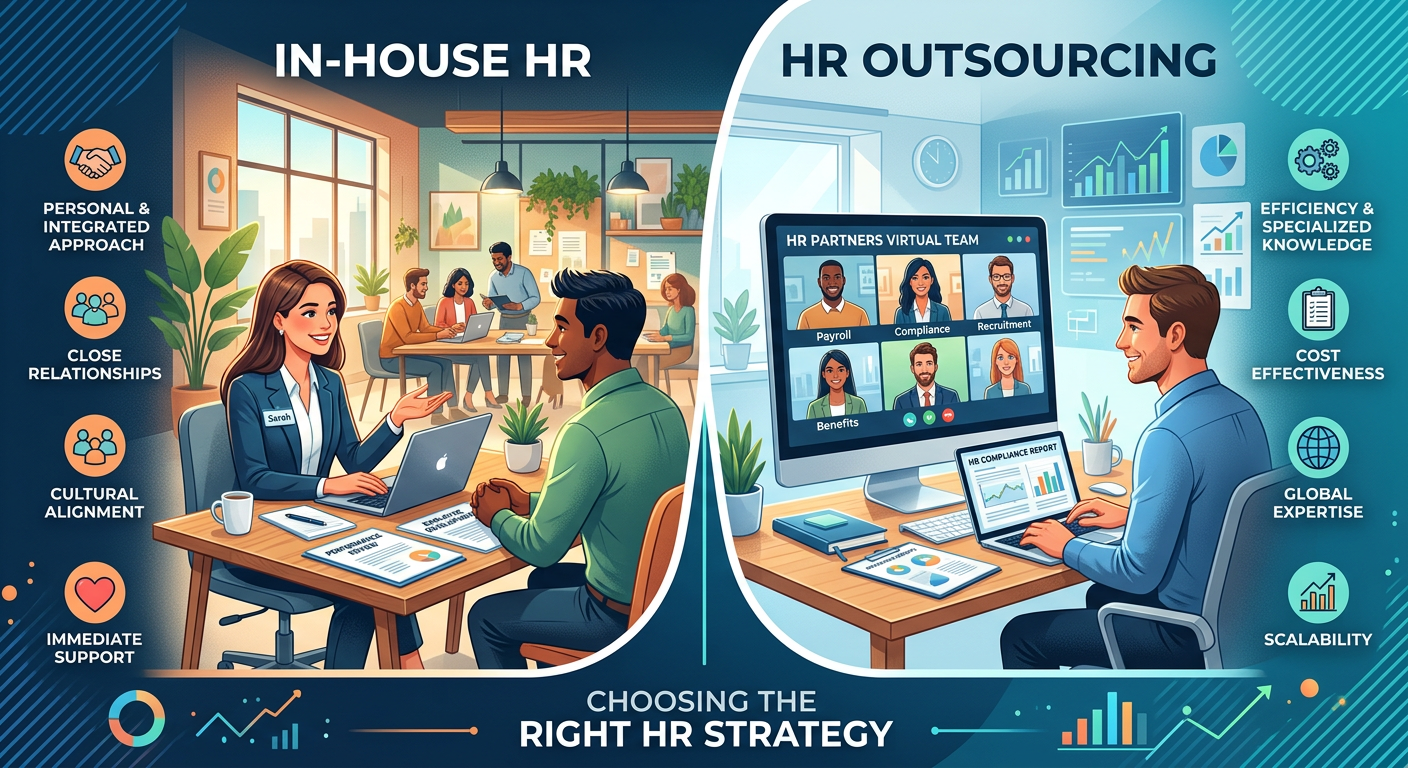
There Is No One-Size-Fits-All HR Solution
As businesses grow, HR becomes increasingly important.
Hiring accelerates.
Compliance requirements expand.
Managers need support.
Processes become more complex.
Eventually, every business reaches the same question:
"Should we hire internal HR or outsource it?"
The answer depends less on company size and more on the complexity of your HR needs, your budget, and how your organization operates.
What Is In-House HR?
An in-house HR team consists of employees dedicated to managing your organization's HR function.
Depending on the size of the company, this may include:
- an HR Coordinator
- an HR Generalist
- an HR Manager
- an HR Director
- specialized HR roles
The HR team becomes embedded within the organization and manages day-to-day HR responsibilities.
What Is HR Outsourcing?
HR outsourcing involves partnering with an external HR provider to perform some or all HR responsibilities.
Depending on the engagement, outsourced HR can include:
- HR operations
- compliance support
- employee relations guidance
- policy development
- HRIS implementation and administration
- recruiting support
- payroll support
- strategic HR consulting
Outsourcing allows businesses to access HR expertise without immediately building a full internal department.
The Advantages of In-House HR
For many organizations, internal HR offers significant benefits.
Greater Organizational Familiarity
Internal HR professionals develop deep knowledge of:
- company culture
- leadership styles
- employee relationships
- organizational history
This familiarity can improve decision-making.
Daily Accessibility
Employees and managers have immediate access to HR support for:
- employee questions
- coaching
- workplace concerns
- operational guidance
Long-Term Workforce Development
Internal HR often plays an important role in:
- succession planning
- leadership development
- employee engagement
- organizational planning
The Advantages of HR Outsourcing
Outsourcing provides different advantages, particularly for growing businesses.
Access to Broader Expertise
An outsourced HR partner often brings experience from working with organizations across multiple industries and business sizes.
This provides insight into:
- best practices
- compliance updates
- operational improvements
- HR technology
Lower Cost Than Building a Department
Hiring a full HR team involves:
- salaries
- benefits
- training
- software
- recruiting costs
For many small and mid-sized businesses, outsourcing provides access to experienced HR professionals at a significantly lower overall investment.
According to the U.S. Small Business Administration (SBA), outsourcing certain business functions can help growing companies manage costs while accessing specialized expertise.
Scalability
Outsourced HR support can often expand as your business grows.
Organizations can add services such as:
- compliance support
- HRIS implementation
- manager coaching
- recruiting support
- HR operations consulting
without hiring multiple full-time employees.
Specialized Knowledge
Many outsourced HR firms maintain expertise in areas such as:
- employment law
- compliance
- HR technology
- process improvement
- organizational development
This can be especially valuable during periods of rapid growth.
The Challenges of Each Approach
Every model has trade-offs.
Challenges of In-House HR
Building an internal HR department may involve:
- higher fixed costs
- longer hiring timelines
- limited specialized expertise depending on team size
- capacity constraints as the business grows
A single HR Generalist often cannot specialize in every HR discipline.
Challenges of HR Outsourcing
Successful outsourcing depends on selecting the right partner.
Potential challenges include:
- choosing a provider that understands your business
- clearly defining responsibilities
- establishing communication expectations
The relationship should feel like an extension of your leadership team—not an outside vendor.
Which Businesses Typically Benefit Most from HR Outsourcing?
While every organization is different, outsourcing often works well for businesses that:
- have between 20 and 250 employees
- are growing quickly
- need stronger HR processes
- do not yet require a full HR department
- are implementing new HR systems
- need compliance guidance
Many organizations eventually transition to internal HR leadership while continuing to leverage outside expertise.
Which Businesses May Benefit from In-House HR?
Internal HR often becomes more valuable when organizations require:
- daily employee support
- multiple HR specialties
- dedicated talent development
- ongoing organizational planning
- larger-scale workforce management
The decision should be based on operational complexity rather than employee count alone.
A Third Option Many Businesses Overlook
The decision is not always "outsource everything" or "hire internally."
Many growing businesses benefit from a hybrid approach.
For example:
- internal HR handles daily employee support
- an external consultant provides compliance guidance
- HR operations are optimized by outside specialists
- HR technology is managed by experienced consultants
This model combines internal familiarity with external expertise.
According to Deloitte, organizations increasingly use flexible workforce models to access specialized expertise while maintaining operational agility.
Questions to Ask Before Making a Decision
Before deciding, ask yourself:
- Are our HR challenges operational or staffing-related?
- Do we need strategic HR expertise or day-to-day administrative support?
- Are our HR processes already structured?
- Can our budget support a full HR department?
- Would outside expertise accelerate improvements?
These questions often clarify the right direction.
If This Is Happening in Your Business, It May Be Time to Explore HR Outsourcing
These are common indicators:
- leadership spends excessive time on HR issues
- managers follow inconsistent processes
- compliance feels difficult to manage
- HR systems are underutilized
- hiring and onboarding lack consistency
- the business has outgrown informal HR practices
If several of these sound familiar, outsourced HR support may provide immediate value.
Recommendation Going Forward
The decision between HR outsourcing and in-house HR should not be based solely on employee count.
It should be based on what your business needs to operate effectively today while preparing for tomorrow.
At HRLaunch Technology, we work with organizations that are not quite ready for a full internal HR department, as well as businesses that already have HR staff but need additional operational expertise.
Our services include:
- HR operations assessments
- HR process design
- compliance support
- HRIS selection and implementation
- HRIS administration
- workforce lifecycle management
- project-based HR consulting
- ongoing operational HR support
Rather than replacing your team, we help strengthen it by building the processes, systems, and operational structure that allow HR to scale with your business.
The goal is not simply to decide between outsourcing and hiring internally.
It is to build an HR function that supports long-term growth.
Final Thoughts
HR outsourcing and in-house HR are not competing solutions.
They are different approaches to solving different business needs.
Some organizations benefit from building an internal HR department.
Others gain greater value from outsourced expertise.
Many achieve the best results by combining both.
The right decision is the one that gives your business the structure, consistency, and expertise it needs to continue growing with confidence.
Sources
U.S. Small Business Administration – Hire and Manage Employees
https://www.sba.gov/business-guide/manage-your-business/hire-manage-employees
SHRM – Outsourcing HR: When It Makes Sense
https://www.shrm.org/topics-tools/topics/hr-outsourcing
Deloitte – 2024 Global Human Capital Trends
https://www.deloitte.com/us/en/insights/topics/talent/human-capital-trends.html
WorldatWork – Human Resources Trends and Workforce Strategy Resources