One of the Biggest HR Problems Is Often Ownership
In many growing businesses, HR challenges are not caused by lack of effort.
They are caused by unclear ownership.
Managers assume HR owns something.
HR assumes managers own it.
And employees get inconsistent experiences as a result.
As companies grow, this becomes increasingly difficult to manage.
Why Ownership Matters More as Companies Scale
At smaller company sizes:
- communication is direct
- teams operate informally
- decisions happen quickly
But growth changes complexity.
As organizations add:
- employees
- managers
- departments
- systems
unclear ownership creates operational friction quickly.
The Goal Is Not Separation — It Is Alignment
HR and managers should not operate independently.
They should work together.
The difference is understanding:
- who owns the process
- who executes day-to-day responsibilities
- who supports consistency and accountability
Without that clarity, workflows become inconsistent.
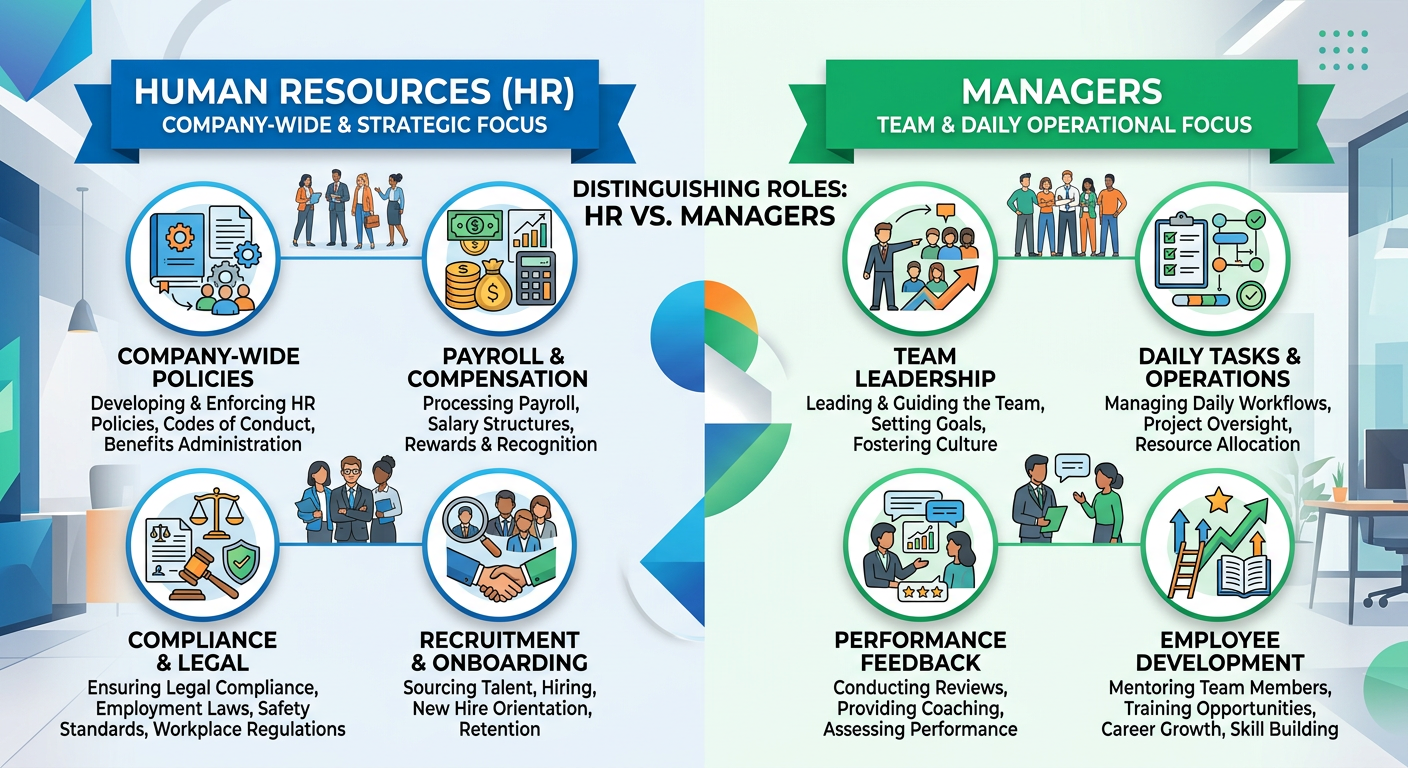
What HR Should Typically Own
HR ownership focuses on structure, consistency, compliance, and operational alignment.
1. HR Policies and Compliance
HR should own:
- employee handbook management
- policy creation and updates
- compliance tracking
- regulatory alignment
This ensures consistency across the organization.
According to the Society for Human Resource Management, clear HR governance and policy ownership are essential for organizational consistency and compliance.
2. HR Systems and Data Management
HR should typically own:
- HRIS administration
- employee data standards
- workflow configuration
- reporting structure
This includes maintaining operational consistency across systems.
3. Process Design and Standardization
HR should define and structure workflows for:
- hiring
- onboarding
- employee lifecycle management
- performance processes
- offboarding
Managers may execute portions of these workflows, but HR should ensure consistency.
4. Compliance Documentation and Recordkeeping
HR should maintain oversight of:
- personnel documentation
- leave records
- training tracking
- accommodation documentation
This reduces organizational risk.
5. Organizational HR Strategy
HR should help guide:
- workforce planning
- compensation structure
- HR operational scalability
- employee experience frameworks
This ensures alignment with business growth.
What Managers Should Typically Own
Managers own day-to-day team leadership and operational execution.
1. Day-to-Day Employee Management
Managers should own:
- coaching and feedback
- workload management
- team communication
- performance discussions
HR supports the structure, but managers lead the people.
2. Hiring Decisions
HR may structure the hiring process.
But managers should typically own:
- evaluating role fit
- team alignment decisions
- day-to-day expectations for the role
Hiring should be collaborative, not isolated.
3. Employee Development
Managers should drive:
- ongoing development conversations
- skill growth
- mentorship and coaching
- performance improvement support
Employees experience leadership primarily through managers.
4. Team Accountability
Managers should own:
- enforcing expectations
- operational accountability
- team performance management
HR supports consistency and documentation, but managers lead execution.
5. Workplace Culture at the Team Level
Culture is not built through policies alone.
Managers shape culture daily through:
- communication
- leadership behavior
- consistency
- accountability
Where Companies Commonly Get This Wrong
Problems usually appear in one of two ways.
HR Owns Too Much
In some companies:
- managers avoid employee conversations
- HR becomes responsible for all people issues
- operational leaders disengage from workforce management
This creates dependency on HR for basic leadership responsibilities.
Managers Own Too Much Without Structure
In other organizations:
- managers create their own processes
- policies are interpreted differently
- onboarding and performance management vary widely
This creates inconsistency and compliance risk.
The Best HR Environments Balance Ownership Clearly
Strong organizations create alignment between:
- HR operational structure
- manager execution
- leadership accountability
The goal is consistency without unnecessary bureaucracy.
According to Harvard Business Review — Managers Can’t Do It All, organizations function more effectively when leadership responsibilities and operational ownership are clearly defined.
If This Is Happening in Your Business, Ownership May Be Unclear
These are common indicators:
- managers handle employee issues inconsistently
- HR becomes involved in every conflict
- onboarding varies by department
- performance management feels reactive
- workflows depend heavily on specific individuals
If several of these are true, the issue is likely ownership and operational structure.
How to Create Better Alignment Between HR and Managers
Improvement starts with clarity.
Define Ownership Explicitly
Document:
- who owns each workflow
- who executes daily responsibilities
- who maintains compliance and oversight
Standardize Core Processes
Ensure managers follow consistent workflows for:
- hiring
- onboarding
- performance management
- employee issues
Train Managers Operationally
Many managers are promoted without training on people management expectations.
Provide structure and support.
Align Systems With Responsibility
HR systems should reflect operational ownership clearly through workflows and approvals.
According to MIT Sloan Management Review — The Manager’s Role in Employee Experience, employee experience and operational consistency improve significantly when managers are clearly supported within structured organizational systems.
How HRLaunch Technology Helps
At HRLaunch Technology, we help organizations create operational clarity between HR responsibilities and manager responsibilities.
Many growing businesses experience friction because ownership evolves informally instead of intentionally.
Our approach focuses on:
- evaluating HR workflows and operational responsibilities
- identifying ownership gaps and inconsistencies
- designing structured, repeatable HR processes
- aligning managers, HR teams, systems, and workflows
We work with small, mid-sized, and growing businesses to build HR operations that create consistency without unnecessary complexity.
The goal is not to shift all responsibility to HR.
It is to ensure the right responsibilities are owned by the right people.
Final Thoughts
HR and managers should not operate separately.
They should operate in alignment.
HR creates structure, consistency, and operational support.
Managers lead people and execute daily team operations.
When ownership is unclear, friction increases.
When ownership is aligned, HR becomes significantly more effective across the organization.
Sources
SHRM — Managing Employee Relations - https://www.shrm.org/topics-tools/topics/employee-relations
Harvard Business Review — Managers Can’t Do It All - https://hbr.org/2024/01/managers-cant-do-it-all
MIT Sloan Management Review — The Manager’s Role in Employee Experience - https://sloanreview.mit.edu/article/the-managers-role-in-employee-experience/
U.S. Department of Labor — Employment Laws Assistance for Workers and Small Businesses - https://www.dol.gov/general/aboutdol/majorlaws