The Expectation vs Reality of HR Systems
When organizations invest in an HRIS, there is often a strong expectation:
“This will fix our HR problems.”
And in some ways, it helps.
Processes become more visible.
Data becomes more centralized.
Manual work can be reduced.
But many companies are surprised when issues still exist after implementation.
That is because an HRIS is a tool—not a solution on its own.
What an HRIS Is Designed to Do
An HRIS is built to support and streamline HR operations.
When properly configured and aligned, it can provide meaningful value.
Centralize Employee Data
An HRIS acts as a single source of truth for employee information.
This includes:
- personal and employment data
- job roles and organizational structure
- compensation and employment history
Centralization improves visibility and reduces duplication.
Standardize Workflows
HR systems help create consistency in how processes are handled.
This includes:
- onboarding workflows
- approvals and employee changes
- performance management processes
Standardization reduces variability across teams.
Improve Reporting and Visibility
An HRIS enables organizations to:
- generate reports
- track key metrics
- analyze workforce data
According to research from Gartner, organizations that effectively use HR technology improve visibility into workforce trends and decision-making.
Source
Gartner HR Technology Research - https://www.gartner.com/en/human-resources
Reduce Manual Work
Automation is one of the key benefits of an HRIS.
It can:
- eliminate repetitive administrative tasks
- trigger notifications and reminders
- streamline approvals
This improves efficiency and saves time.
Support Compliance Tracking
HR systems can help track:
- required documentation
- training completion
- compliance-related activities
However, tracking alone does not ensure compliance.
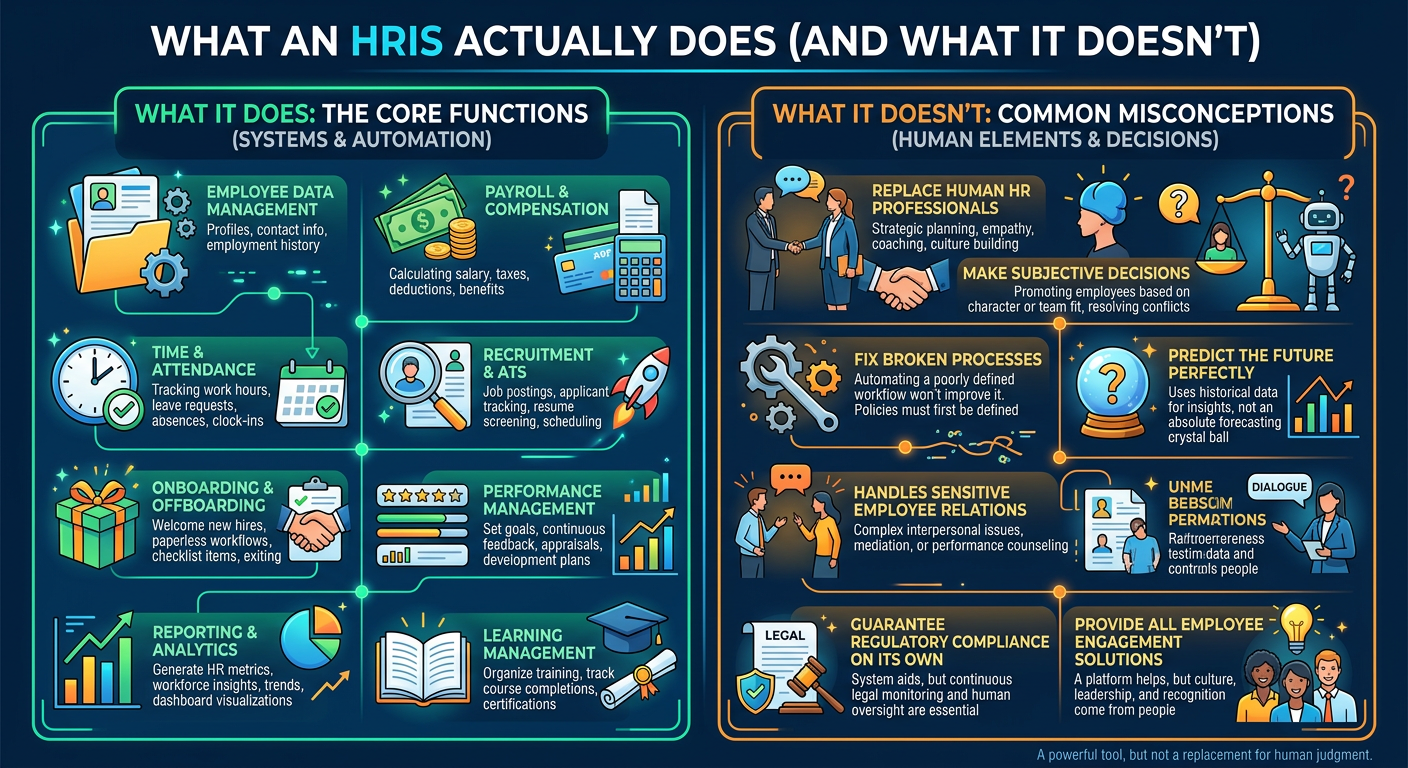
What an HRIS Does Not Do
This is where expectations often do not match reality.
It Does Not Define Your Processes
An HRIS cannot determine:
- how your hiring process should work
- how approvals should be structured
- how employee issues should be handled
If processes are unclear, the system will reflect that.
It Does Not Fix Broken Workflows
If workflows are inconsistent before implementation:
- they will remain inconsistent in the system
- or become more complex
The system does not correct underlying issues.
It Does Not Clean or Standardize Your Data
An HRIS relies on the data it is given.
If data is:
- inconsistent
- incomplete
- duplicated
those issues will continue in the system.
It Does Not Replace Decision-Making
HR systems provide data.
They do not:
- make decisions
- define strategy
- determine priorities
Decisions still require human judgment and structure.
It Does Not Ensure Compliance on Its Own
While systems can track compliance-related activities, they do not guarantee that:
- policies are applied consistently
- managers follow processes
- requirements are fully met
According to the U.S. Department of Labor, compliance depends on employer practices, not just tools.
Why This Distinction Matters
Understanding what an HRIS does and does not do is critical.
When expectations are misaligned:
- systems are blamed for process issues
- implementations become more difficult
- adoption decreases
Organizations may assume they need a different system when the issue is elsewhere.
If This Is Happening in Your Business, Expectations May Be Misaligned
These are common indicators that expectations of your HRIS may not match reality:
- processes are still unclear after implementation
- manual work continues despite having a system
- data is inconsistent or unreliable
- workflows vary across teams
- system features are underutilized
If several of these are true, the issue is not the system.
It is how it is being used.
How to Get More Value From Your HRIS
Maximizing the value of an HRIS requires more than implementation.
Define Processes Before Configuration
Ensure workflows are clearly defined before building them into the system.
Align Systems With Operations
Configure the system to reflect how your business actually operates.
Improve Data Structure
Standardize and clean data to support accurate reporting.
Focus on Adoption
Ensure users understand how to use the system consistently.
How HRLaunch Technology Helps
At HRLaunch Technology, we help organizations get the most out of their HR systems by aligning them with how HR actually operates.
Many challenges that appear to be system limitations are caused by gaps in processes, data, and structure.
Our approach focuses on:
- evaluating current HR operations and system usage
- identifying gaps in workflows, data, and alignment
- designing structured processes that systems can support
- optimizing HRIS configuration to improve efficiency and visibility
We work with small, mid-sized, and growing businesses to ensure their HR systems are not just implemented, but effective.
The goal is to align systems, processes, and data so the HR function operates consistently and supports business growth.
Final Thoughts
An HRIS is a powerful tool.
But it is not a complete solution.
It can support processes, improve visibility, and reduce manual work.
It cannot replace structure, clarity, or decision-making.
Understanding this difference helps organizations make better decisions about how to use HR systems effectively.
And ultimately, how to build HR that works.