When “Live” Doesn’t Mean “Working”
For many organizations, implementing an HR system feels like a major milestone.
The system is live.
Employees are in the platform.
Payroll runs successfully.
From the outside, the implementation appears complete.
But in many cases, what exists is not a fully functioning HR system.
It is a partially configured platform used only for basic tasks.
The Gap Between Implementation and Optimization
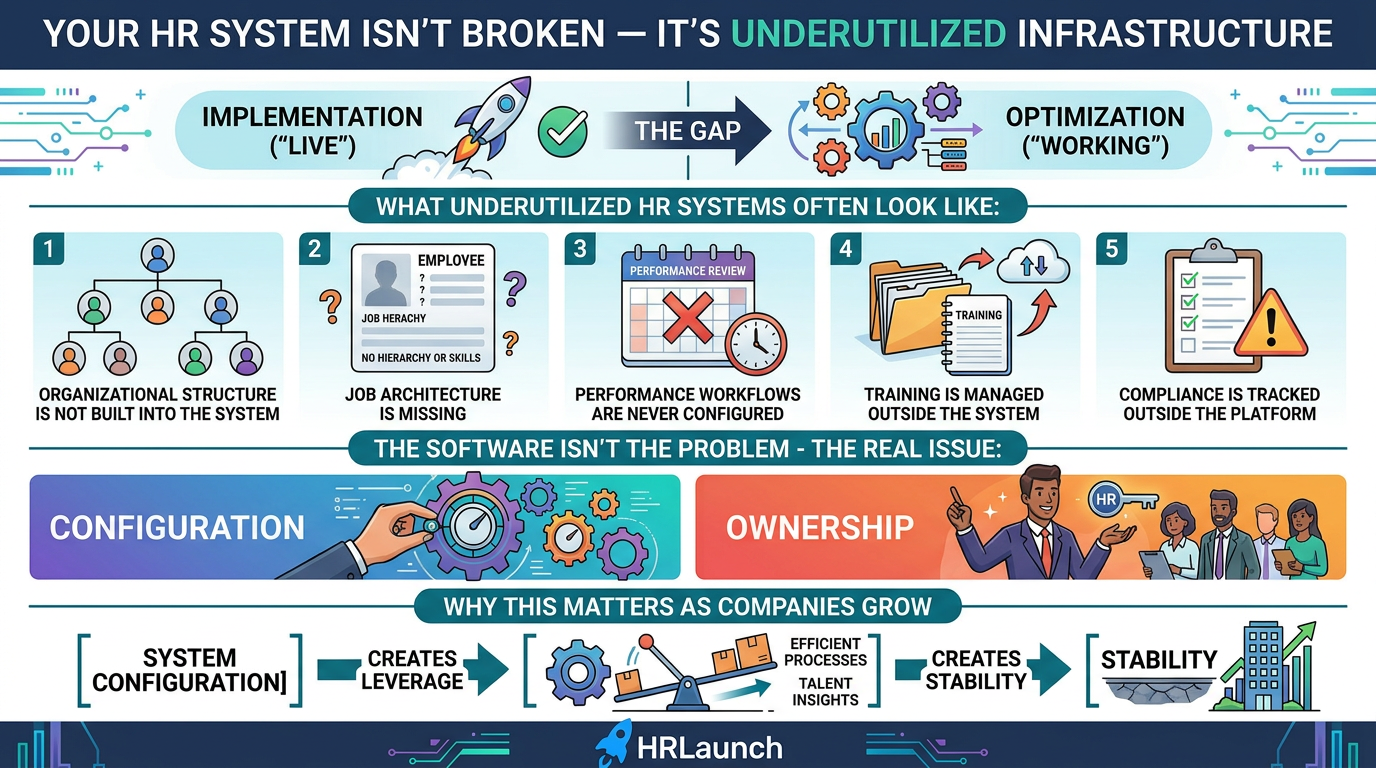
An HR system being live is not the same as it being optimized.
Most platforms are capable of supporting:
- employee lifecycle management
- structured workflows
- reporting and analytics
- compliance tracking
- performance management
But many organizations only use a small portion of that functionality.
This creates a gap between what the system can do and how it is actually being used.
What Underutilized HR Systems Often Look Like
Across growing organizations, the same patterns tend to appear.
Organizational Structure Is Not Built Into the System
Instead of reflecting the company’s actual structure, the HR system may contain:
- incomplete department hierarchies
- inconsistent reporting relationships
- limited visibility into team structure
Without this foundation, reporting and workforce planning become difficult.
Job Architecture Is Missing
Job titles, levels, and classifications are often inconsistent or undefined.
This leads to:
- unclear career paths
- inconsistent compensation structures
- difficulty analyzing workforce data
A structured job architecture is critical for scaling HR operations.
Performance Workflows Are Never Configured
Many HR systems include performance management tools, but they are often left unused.
As a result:
- Performance reviews are handled manually
- Feedback processes vary across managers
- Employee development lacks consistency
The system exists, but the process does not.
Training Is Managed Outside the System
Training and development are frequently tracked through:
- spreadsheets
- external tools
This creates:
- Limited visibility into employee development
- Inconsistent training completion tracking
- Challenges in maintaining compliance records
Compliance Is Tracked Outside the Platform
Even when HR systems include compliance features, organizations often manage compliance separately.
This can result in:
- missing documentation
- inconsistent policy tracking
- increased risk during audits
The Software Isn’t the Problem
When these issues appear, the initial reaction is often to question the system itself.
Companies may believe:
- The platform lacks functionality
- The system is difficult to use
- A new HR system is needed
In many cases, none of these are true.
The issue is not the software.
It is how the system has been configured and managed.
The Real Issue: Configuration and Ownership
Most HR system challenges come down to two core issues.
Lack of Configuration
Systems are often implemented with minimal setup, focusing only on immediate needs such as payroll and employee records.
Advanced features are left unconfigured because:
- There is limited time during implementation
- Processes are not clearly defined
- Internal resources are stretched
Lack of Ownership
HR systems require ongoing ownership.
Without clear accountability:
- No one is responsible for system optimization
- Workflows are not updated as the company grows
- Data becomes inconsistent over time
The system becomes static while the organization continues to evolve.
Why This Matters as Companies Grow
As organizations scale, underutilized systems create increasing friction.
This can lead to:
- Manual workarounds that reduce efficiency
- Inconsistent HR processes across departments
- Limited visibility into workforce data
- Difficulty supporting compliance requirements
Over time, these challenges compound and make HR operations harder to manage.
Configuration Creates Leverage
When HR systems are properly configured, they create operational leverage.
This means:
- Workflows are automated
- Approvals are standardized
- Data is centralized and accurate
- Reporting becomes reliable
Instead of reacting to HR needs, organizations can operate with structure and consistency.
Leverage Creates Stability
With the right configuration and ownership in place, HR systems become a stable foundation for the business.
Organizations gain:
- consistent employee experiences
- better decision-making through data
- improved compliance tracking
- scalable HR operations
Stability allows companies to grow without constantly reworking their processes.
How HRLaunch Technology Helps
At HRLaunch Technology, we work with organizations to move beyond basic HR system usage and fully optimize their HR technology.
Our approach focuses on:
- evaluating current HRIS configuration
- identifying gaps in workflows and data structure
- aligning systems with business operations
- establishing ownership and ongoing system management
The goal is not just to have a system in place, but to ensure it is working effectively for the organization.
Final Thoughts
Most organizations do not have an HR technology problem.
They have an underutilization problem.
When HR systems are treated as infrastructure rather than just software, they can provide the structure and efficiency needed to support growth.
Configuration creates leverage.
Leverage creates stability.