Most HR Problems Are Easier to Fix Than They Are to Find
Many business leaders know something feels off in HR.
Hiring feels inconsistent.
Managers handle employee issues differently.
Reporting is difficult.
Processes seem more complicated than they should be.
The challenge is not always fixing the problem.
The challenge is identifying where the problem actually exists.
That is why periodic HR audits are valuable.
What Is an HR Audit?
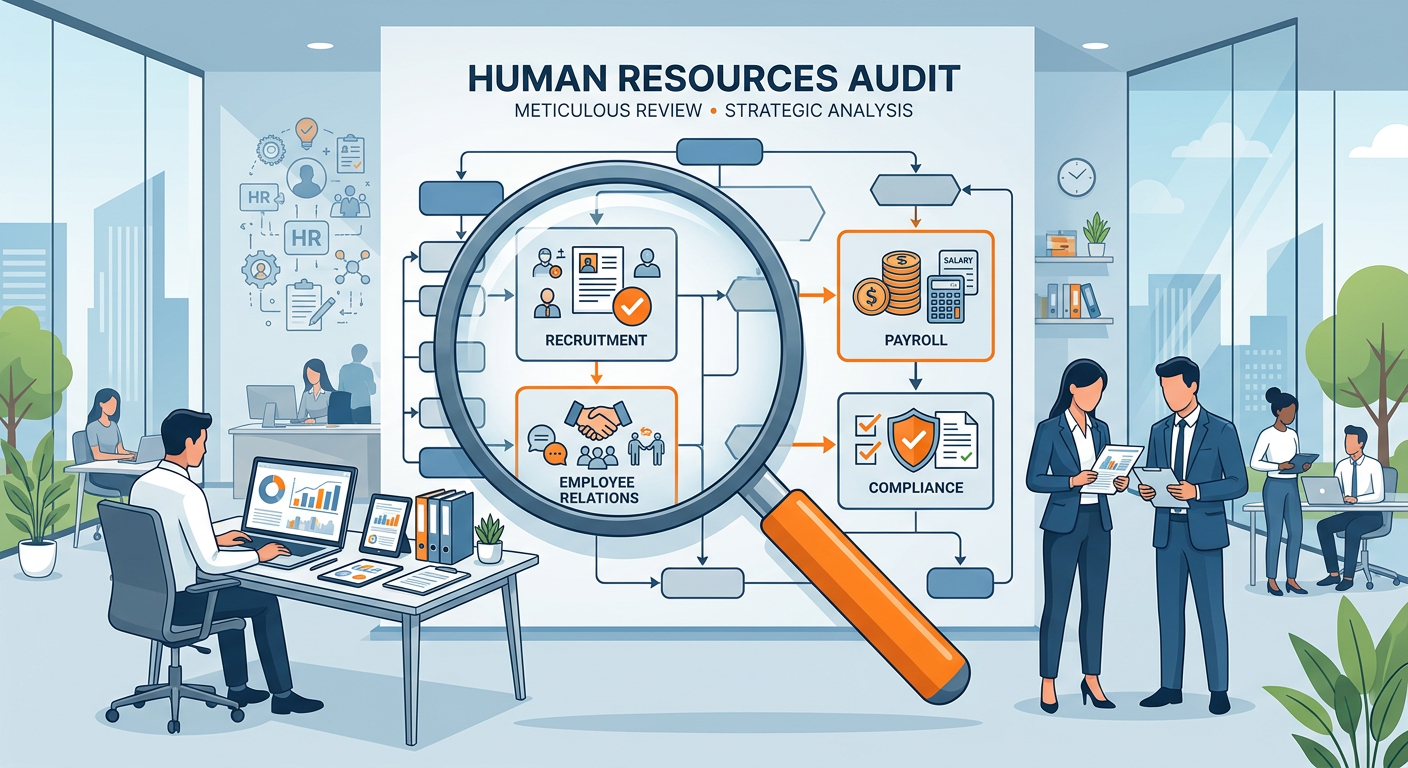
An HR audit is a structured review of how HR currently operates.
Its purpose is to evaluate:
- compliance
- processes
- systems
- documentation
- operational consistency
The goal is not to create more work.
The goal is to identify gaps before they become larger problems.
Why Growing Businesses Often Skip HR Audits
Many organizations assume audits are only necessary for large companies.
Others believe they need:
- a dedicated HR department
- outside legal counsel
- a large consulting engagement
before they can evaluate HR effectively.
In reality, most businesses can perform an initial HR assessment internally.
The key is knowing what to review.
Step 1: Review Your Core HR Processes
Start by evaluating the workflows that impact employees most often.
Hiring
Ask:
- Is there a documented hiring process?
- Do managers follow the same process?
- Are interview practices consistent?
- Is hiring documentation maintained?
Inconsistent hiring often signals larger operational gaps.
Onboarding
Review:
- onboarding checklists
- training assignments
- documentation collection
- employee introductions
A strong onboarding process should be repeatable regardless of department.
Employee Lifecycle Management
Evaluate how your company handles:
- promotions
- transfers
- compensation changes
- employee exits
If these processes vary significantly across teams, consistency may be lacking.
Step 2: Evaluate Compliance Readiness
Many compliance risks remain hidden until an issue occurs.
Review whether you have:
- current labor law posters
- updated employee handbook
- documented policies
- harassment prevention practices
- required employee documentation
According to the U.S. Department of Labor, employers are responsible for maintaining numerous employment-related compliance obligations that evolve as businesses grow.
Review Documentation Practices
Ask:
- Are employee records complete?
- Is documentation centralized?
- Are performance conversations documented?
- Are compliance records maintained consistently?
Poor documentation is one of the most common hidden risks in growing businesses.
Step 3: Assess Manager Consistency
Many HR challenges originate at the manager level.
Review whether managers follow consistent practices regarding:
- hiring
- onboarding
- performance management
- employee coaching
- disciplinary actions
If every manager operates differently, HR is likely dependent on individual habits rather than structured processes.
Step 4: Evaluate Your HR Technology
Technology should support operations.
Not create additional complexity.
Review:
- HRIS utilization
- payroll processes
- onboarding workflows
- reporting capabilities
- employee data management
Many organizations discover they are only using a fraction of their HR system's capabilities.
Ask a Simple Question
"Are we managing processes inside the system or outside the system?"
If spreadsheets, email chains, and manual tracking still dominate workflows, there may be opportunities for improvement.
Step 5: Review HR Reporting and Data
Leadership should be able to answer basic workforce questions.
For example:
- How long does hiring take?
- What is our turnover rate?
- Where are compliance risks emerging?
- Which departments experience the highest attrition?
If obtaining these answers requires significant manual effort, data management may need attention.
According to Visier, workforce visibility remains one of the biggest barriers to effective people management and workforce planning.
Step 6: Identify Operational Bottlenecks
Look for areas where HR work repeatedly slows down.
Examples include:
- approval delays
- onboarding bottlenecks
- reporting issues
- manager escalation challenges
- compliance tracking
Recurring bottlenecks often reveal structural issues.
Step 7: Evaluate Ownership
One of the most overlooked parts of an HR audit is ownership.
Ask:
- Who owns onboarding?
- Who owns compliance tracking?
- Who owns HR systems?
- Who owns reporting?
If responsibilities are unclear, accountability becomes difficult.
Common Audit Findings in Growing Businesses
Organizations frequently discover:
- inconsistent hiring practices
- outdated policies
- manual compliance tracking
- underutilized HR systems
- fragmented employee data
- unclear ownership
- onboarding inconsistencies
Most of these issues develop gradually over time.
If This Is Happening in Your Business, an HR Audit Is Probably Overdue
These are common indicators:
- managers handle HR differently
- onboarding varies by department
- reporting requires spreadsheets
- compliance tracking is manual
- employee documentation is inconsistent
- HR issues seem to repeat regularly
If several of these sound familiar, there are likely operational gaps worth evaluating.
What an Effective HR Audit Produces
A good audit should provide clarity around:
- process gaps
- compliance risks
- technology utilization
- operational inefficiencies
- ownership concerns
The outcome should be a roadmap for improvement.
Not a list of problems without solutions.
Recommendation Going Forward
Before assuming you need additional HR staff, take time to understand how your current HR function operates.
Many challenges that appear to require more personnel are actually the result of:
- unclear processes
- inconsistent workflows
- fragmented systems
- operational gaps
At HRLaunch Technology, we help organizations evaluate their HR operations, identify opportunities for improvement, and build practical HR foundations that support growth and compliance.
Whether your business has no dedicated HR professional, a single HR generalist, or an operations-led HR function, understanding your current state is the first step toward improvement.
The goal is not simply to find problems.
It is to create a clear path toward a stronger HR function.
Final Thoughts
You do not need a full HR team to understand whether your HR function is working effectively.
What you need is visibility.
A structured HR audit helps reveal the gaps, inefficiencies, and risks that often remain hidden during day-to-day operations.
Because the sooner you understand how HR is functioning today, the easier it becomes to improve it tomorrow.
Sources
U.S. Department of Labor – Employment Laws Assistance for Workers and Small Businesses - https://www.dol.gov/general/aboutdol/majorlaws
SHRM – Conducting an HR Audit - https://www.shrm.org/topics-tools/tools/hr-answers/conduct-hr-audit
Visier – Workforce Planning and Analytics Insights - https://www.visier.com/blog/
Society for Human Resource Management (SHRM) – HR Strategy Resources - https://www.shrm.org/topics-tools/topics/hr-strategy